Memorandum
Sigils, Terms Declared
What a sigil is, how it's supposed to work, and how to make one with nothing but a pen

This is science, so we declare our terms before we start waving our hands around.
Not lab-coat science. The other kind, the older kind: say exactly what you mean by each word, do the thing, write down what happened, and let somebody else try it. Everything below is a procedure. You can run it tonight with a pen and a scrap of paper, and you can check your results in a month.
A sigil is the oldest hack I know for getting a want out of your head and into the part of you that actually does things. People have been drawing them for at least five hundred years, the methods are public, and none of them cost a cent. Here is what the words mean, how the thing is supposed to work, the common ways to make one, and the one method I’d hand anybody first: Austin Osman Spare’s.
Same terms as the other memos: I said what I wanted this to say, and Claude did the reading and drafted it.
The terms
These are the words this piece uses, and what each one means here. Other people use them differently. That’s fine; these are ours.
| Term | What we mean by it |
|---|---|
| Sigil | A mark you make on purpose to stand for one desire, built so you can’t read the desire back out of it at a glance. |
| Statement of intent | The sentence you start from. Short, specific, and said as if it’s already true. |
| Reduction | Whatever process turns the sentence into a shape: striking letters, walking a square, tracing a wheel. The reduction is the method. |
| Charging | Putting the finished sigil in front of your mind at a moment when the chatter is switched off, so it lands underneath your thinking instead of on top of it. |
| Gnosis | The state you charge in. Either still and empty (staring, breathing, the edge of sleep) or flooded and loud (dancing, running, music up too high). |
| Forgetting | Cutting the conscious link between the shape and the words. You stop checking on it. Spare called the thing that gets in the way “lust of result”. |
| Kamea | A planetary magic square: a grid of numbers tied to one of the seven classical planets, where every row, column and diagonal adds to the same total. Used as a map to walk a sentence across. |
| Result | Whatever you said you’d count as the desire happening, written down before you charge. No result declared, no science. |
How they work
There are two ways to read what a sigil does, and the procedure is the same under both. Pick the one you can live with. You can swap later.
The old claim. Austin Osman Spare laid it out in The Book of Pleasure (1913). Your conscious mind is the bottleneck. It wants things loudly, doubts them, checks on them, and worries the want to death. Spare’s name for that interference was lust of result. So you disguise the desire as a shape the conscious mind can’t read, slip it in underneath during a moment when your thinking is switched off, and then forget it. Down there, the theory goes, it gets to work without you standing over it.
The plain reading. Writing down exactly what you want, in one sentence, is already most of the battle. Most people never get that specific. Making the sigil forces you to sit with the sentence until it’s right. Drawing it by hand burns it in. Charging it is a little ritual, and rituals settle nerves. Forgetting it stops you nagging yourself, while the sharpened want keeps steering what you notice and what you do. The nearest thing psychologists have actually studied is Peter Gollwitzer’s work on implementation intentions: people who spell out a specific plan follow through more often than people who only hold a goal. That’s a cousin of a sigil, not proof of one.
Chaos magicians made a principle out of that split: belief is a tool. You take up the frame that gets results, run it, and put it down. You don’t have to believe a single word of the old claim for the procedure to be worth running. You do have to run it honestly, and that means declaring your result before you start (see Result above).
Common ways to make one
Every method below does the same job: it takes a sentence or a picture of what you want and reduces it to a shape you can’t read. They differ in what the reduction runs on.
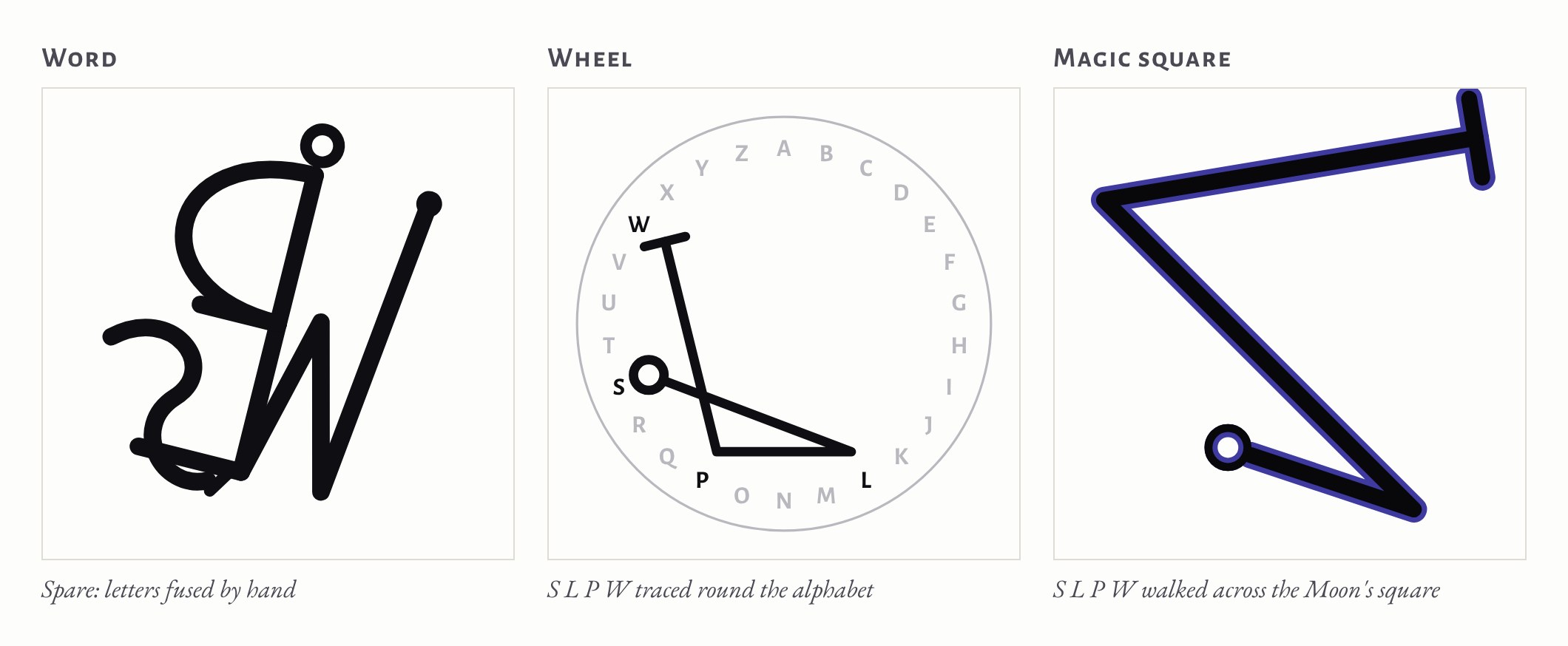
| Method | How it goes | Where it comes from |
|---|---|---|
| Word | Write the sentence, strike the letters that repeat, fuse what’s left into one glyph. | Spare, The Book of Pleasure (1913). The workhorse. |
| Pictorial | Draw the want as a dumb little picture, then simplify it until it stops looking like anything. | Spare again; written up as a method by Peter J. Carroll in Liber Null (1978). |
| Mantric | Strike the letters the same way, then shuffle what’s left into a nonsense word and chant it until it’s just sound. | Carroll’s Liber Null; Frater U.D.’s Practical Sigil Magic. |
| Wheel | Write the alphabet round a circle and draw a line from letter to letter. | The Golden Dawn’s rose cross did it with Hebrew letters; plenty of modern people use a plain A to Z wheel. |
| Magic square | Turn the letters into numbers and walk them across a planetary kamea. | The squares are in Agrippa’s Three Books of Occult Philosophy (1533); Agrippa’s own planetary spirit seals were drawn this way. |
| Automatic | Hold the want in mind and let your hand scribble with your brain out of the way. Keep the shape that grabs you. | Spare’s automatic drawing; every doodler who ever lived. |
| Hypersigil | Make a whole work, a story, a comic, an album, as one giant sigil, and live inside it while you make it. | Grant Morrison’s word, for The Invisibles. |
You can mix them. A word sigil drawn inside a wheel. A mantric chant over a square. Nobody is checking your paperwork. The only rule that matters: by the end you can’t read the want back out of the shape.
Spare’s way, step by step
This is the one I’d hand anybody first. It needs a pen, a piece of paper and about ten minutes, and the only skill involved is being honest about what you want.
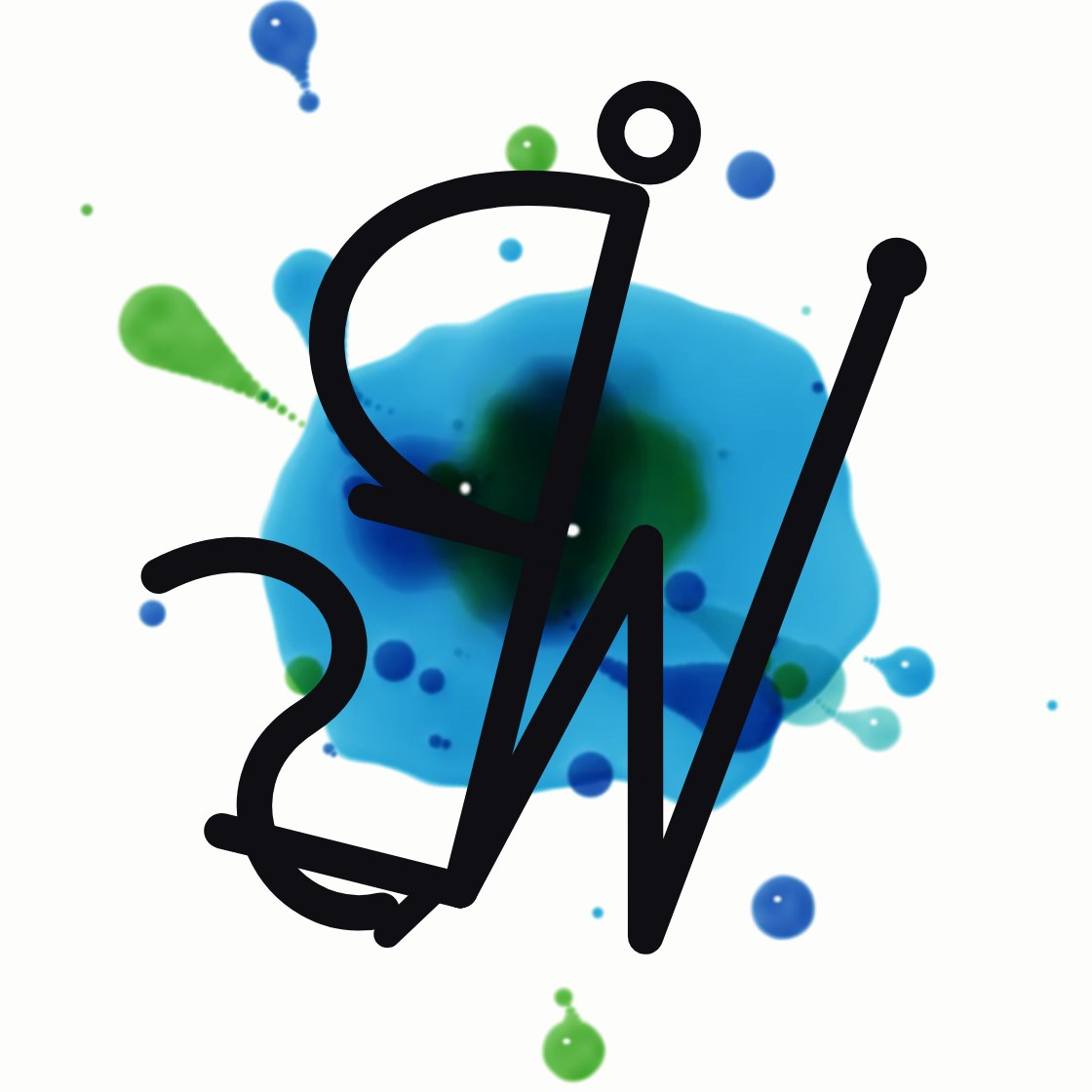
Spare’s own example in The Book of Pleasure was “This my wish to obtain the strength of a tiger.” We’ll do a smaller one: I sleep well.
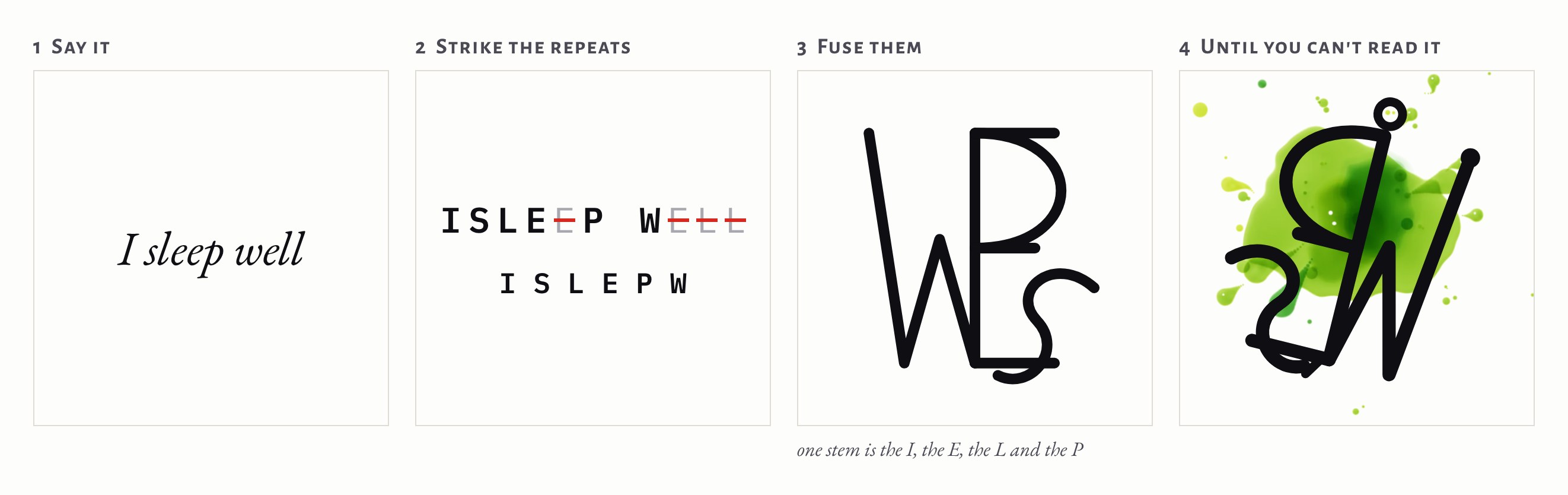
- Say it. One sentence, present tense, as if it’s already true. “I sleep well,” not “I want to stop having insomnia.” Leave the thing you don’t want out of it entirely, because the shape will carry whatever words you feed it.
- Strike the repeats. Write it in capitals and cross out every letter that already appeared. I SLEEP WELL keeps I S L E P W and loses the second and third E and both of the last L’s.
- Optional: strike the vowels too. Spare didn’t. A lot of people do now, because fewer letters make a cleaner shape. I SLEEP WELL that way is just S L P W. Pick one rule and stick to it.
- Fuse them. Draw the leftover letters as one figure. Let them share strokes: here one vertical line is the I, the back of the E, the back of the L and the stem of the P all at once. Turn letters over, mirror them, stretch them. Hang the W off the bottom of the stem and run the S through the middle.
- Keep going until you can’t read it. Drop strokes that don’t need to be there. Add a circle, a dot, a tail if your hand wants one. It’s done when it looks like a symbol and not a word, and you’d recognize it again in a pile of other doodles.
That’s the whole method. No tables, no planets, no Hebrew. You make the shape yourself, by hand, so it carries your hand. The letters are just where you start.
Charging and forgetting
A sigil you made and never charged is a doodle. Charging is the part where you put it in front of your mind while your thinking is switched off.
Carroll split the ways in two, and the split is the handiest thing in Liber Null:
- The quiet way. Shut the mind down until the sigil is the only thing left. Stare at it until your eyes go soft and the edges swim. Breathe slow. Do it on the edge of sleep. Spare’s own trick, the “death posture”, was this kind: hold still and strained until there is nothing left in your head but the shape.
- The loud way. Drive the mind up instead. Dance, run, drum, put the music on far too loud, and hold the sigil in front of you at the peak. Spare, and plenty of people after him, used orgasm. Carroll’s point is that either extreme ends in the same place: one-pointed attention, nothing else on the line.
Then let it go:
- Break the moment. Carroll says to banish with laughter, and he’s right. Laugh at yourself, out loud, on purpose. It works.
- Put the sigil away. Burn it, bury it, tear it up, file it in an envelope: whatever means and implements of destruction you have. I am not responsible for them; you’re on your own recognizance. Just don’t leave it with the rest of the garbage at the bottom of a hill on Thanksgiving. Ask Arlo Guthrie how that went. Out of sight.
- Forget it. Don’t check on it. Don’t wonder if it’s working. That checking is exactly the lust of result the whole method is built to get around.
And the science part: before you charge, write the sentence and the result you’ll count on a card, with a date to look again. Seal it. Open it when the date comes and write down what happened, hits and misses both. A notebook full of those is the only honest answer to “does it work” that you’ll ever get, and it’s yours.
What about the planets?
Planetary sigils are great too. They’re the old-school kind: each of the seven classical planets has its own magic square, every letter becomes a number, and the sigil is the line you get by walking those numbers across the grid. Saturn for endings and the long slow thing, Jupiter for growth and luck, Mars for force, and so on down to the Moon.
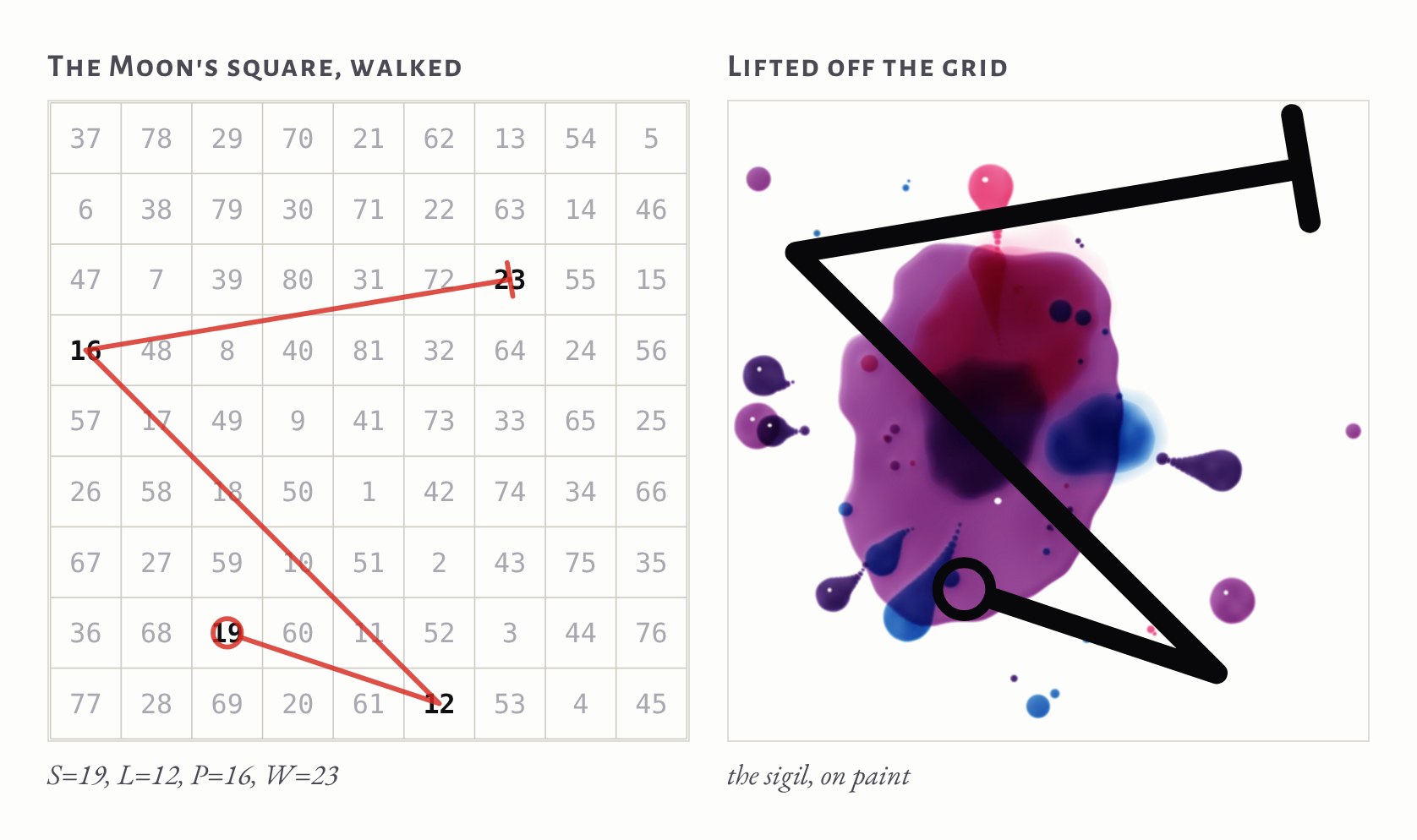
They are also hard to do by hand without a ton of practice. You need the right square, you need to fold the numbers down to fit it, you need to find each cell and walk the line in order, and one slip anywhere puts the line somewhere else. Without that practice, or a good LLM doing the arithmetic for you, it’s a slog.
So here’s the thing: you don’t have to use that shit. Spare’s method works with nothing but you and a pen, and so does every other method in the table above. Art is universal beyond language or planets or structure. The shape you make yourself carries more of you than any grid ever will.
But the planetary shit is cool. So if you want to try it, look HERE: Planetary Sigils For Dummies walks it through like you’re four, and the Sigil Oracle does all the walking for you. Type your sentence, pick a planet, get the line, and see every step of how it got drawn.
Sources
- Austin Osman Spare, The Book of Pleasure (Self-Love): Psychology of Ecstasy (1913). About the book.
- Peter J. Carroll, Liber Null (1978): the word, pictorial and mantric methods, the two kinds of gnosis, banishing with laughter. Carroll died in April 2026; the Illuminates of Thanateros’ notice, and our toast to him.
- Frater U.D., Practical Sigil Magic: Spare’s word method, the pictorial and mantric methods in detail.
- Heinrich Cornelius Agrippa, Three Books of Occult Philosophy (Cologne, 1533). About the book.
- Sigil, for kamea sigils and Grant Morrison’s hypersigil.
- Implementation intention, Peter Gollwitzer’s if-then plans.
The pictures
The sigils on this page were drawn for it. The “I sleep well” sigil follows the method above but was drawn by Claude in code to look like pen work. The Moon’s square and its line come from the Sigil Oracle, which walks the squares the same way the method describes. The paint is from the letterhead’s own paint generator.