
Memorandum
Peter J. Carroll, 1953–2026
A toast to the man who handed sigils to anybody with a pen

Two posts on sigils sit next to this one. Read this one first. Half of what’s in them, the quiet way and the loud way, laughing it off, belief as a tool you pick up and put down, came to most of us through one man. Peter J. Carroll died on 22 April 2026 after a sudden illness. He was 72 or 73, and I found out six months late, when Claude turned it up while checking a footnote.
So before we talk about how to draw a want into a shape, we raise a glass to the guy who took Austin Spare’s back-room sorcery, stripped the incense off it, and handed it to anybody with a pen. Cheers, Pete.
Same terms as the other memos. Claude did the digging through his obituaries and drafted this. The toast is mine.
Who he was
Carroll was born in England in 1953 and trained in chemistry, a field he later waved off as glorified cooking. In the late 1970s he was writing for The New Equinox, a little magazine edited by Ray Sherwin. The two of them announced a new magical order in its pages: the Illuminates of Thanateros, the IOT. Carroll was 25 when Liber Null came out in 1978.
He ran the order through its strange early years, built it into something people around the world could join, and in the 1990s walked away from what he called the roles of “magus and pontiff of chaos”. He kept writing for the rest of his life. He ran an online school, Arcanorium College. In 2005 Robert Anton Wilson asked him to teach chaos magic at Wilson’s Maybe Logic Academy, which is about as Illuminatus! a sentence as real life gets. He sold oils and essences out of an apothecary in Bristol. He was married, had kids, and kept a cellar full of meticulously painted war-game miniatures.
His friend Julian Vayne remembers him as tall, long-haired and bearded, a biker-mage in a leather jacket who, as far as anyone knows, never passed a driving test. Cantankerous, bombastic, sometimes rigid, often very funny, unexpectedly warm. He kept photographs of himself out of wide circulation, and there is no picture of him here.
What he built
Forty-seven years of books, from a skinny brash manual at 25 to a last word on the future of magic the year before he died.
| Year | Book | What it did |
|---|---|---|
| 2025 | This Is Chaos: Embracing the Future of Magic | His last book. |
| 2022 | Interview with a Wizard | Late work. |
| 2014 | Epoch: The Esotericon & Portals of Chaos | An oversized, game-like deck and book with artist Matt Kaybryn. Carroll appears in it as a god at his forge. |
| 2010 | The Octavo: A Sorcerer-Scientist’s Grimoire | Magic written up like a physics text. |
| 2008 | The Apophenion: A Chaos Magic Paradigm | A whole paradigm for chaos magic. |
| 1996 | Psybermagick: Advanced Ideas in Chaos Magick | The advanced ideas, after Liber Kaos. |
| 1992 | Liber Kaos | The order’s manual: temples, rituals, the eight colours of magic, and the equations. |
| 1982 | Psychonaut | A manual for magic done in groups. Joined to Liber Null in one volume in 1987. |
| 1978 | Liber Null | The one. Sigils, gnosis, banishing with laughter, all the old traditions boiled down to method. |
And the order itself: the IOT outlived his leadership by more than thirty years and is still running.
Respectably nuts
Here is a man who made a whole school out of not taking any belief too seriously, and then took everything he did completely seriously. That’s the charm.
- He wrote equations for magic. Real ones, with letters. The odds of a thing happening anyway, nudged by how much magic you throw at it, which comes from your gnosis times your link to the target, cut down by your own buried resistance and your conscious doubt. He talked them over with the parapsychologist Dean Radin. A chemist doing the books on sorcery.
- He borrowed a colour from a comic novel. His eight colours of magic, a shortcut through the old planetary magic, include octarine, the colour of magic from Terry Pratchett’s Discworld, which he loved. The same planets our kamea squares come from, run through a fantasy joke and made to work.
- He picked fights with the Big Bang. His later years went into hypersphere cosmology and a theory of three-dimensional time, published on his own site for anyone to argue with.
- He’d make you roll for your religion. One of his exercises: assign a worldview to each face of a die, roll it, and live as a pagan, or an atheist, or whatever came up, for a set stretch. Then roll again.
- He wouldn’t allow astrology in his order and wrote that magic would never be free of occultism until somebody had “strangled the last astrologer”. He spent about sixteen years in the Order of Bards, Ovates and Druids anyway.
- He ran a Chaos Jihad. At Arcanorium College he and his students aimed magic at things like climate change.
- His favourite gnosis was rage. Of all the loud ways in, he liked summoning anger best.
- He once gave a friend a bottle of caprylic acid and told him it was pure essence of goat. Chemistry joke, magic joke, and goat joke, all in one bottle.
- On having children, he said it was a way to “throw bombs at the future”.
Cantankerous, warm, rigid, wildly inventive, occasionally irritating. Every one of those is on the record from people who loved him. Respectably, gloriously nuts.
What he left us
Not a doctrine, a set of tools. That’s how his friend Julian Vayne put it, and it’s the best thing you can say about a magician.
He made Spare usable. Austin Osman Spare’s sigils were one strange London artist’s private practice, written up in a strange book in 1913. Carroll wrote them down as a method anyone could run: say it, strike it, draw it, charge it, forget it. Most sigil tutorials since descend from that, ours included.
He made belief a tool. Pick up the frame that works, run it, put it down, pick up another. His order boiled it down to one rule: “If it works, use it.” That’s the closest thing magic has to the scientific method, and it’s why our sigil post starts by declaring its terms.
He made laughter part of the ritual. In Liber Null he called laughter the only tenable attitude “in a universe which is a joke played upon itself.” You charge the thing, then you laugh it off. Serious work, unserious about yourself. That is the whole Discordian heart of it.
Draw something. Charge it. Laugh.
Cheers, Pete.
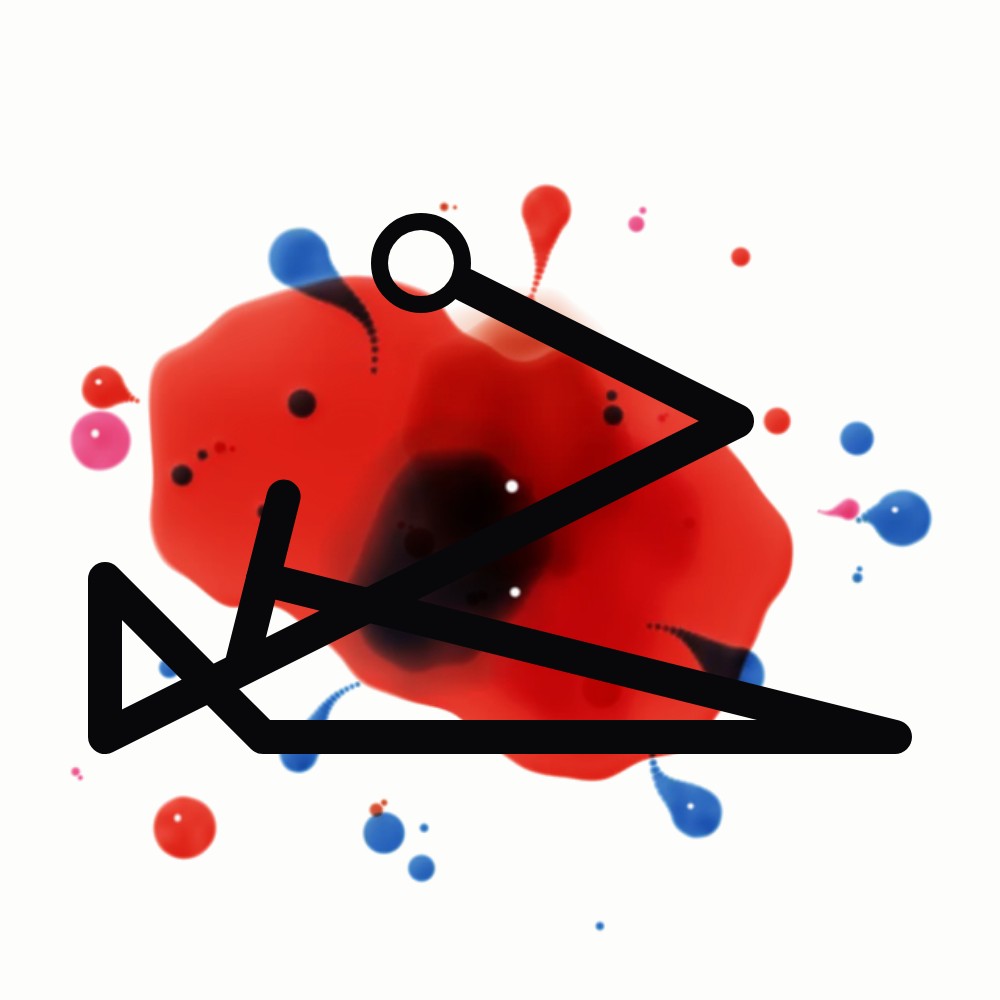
The sigil
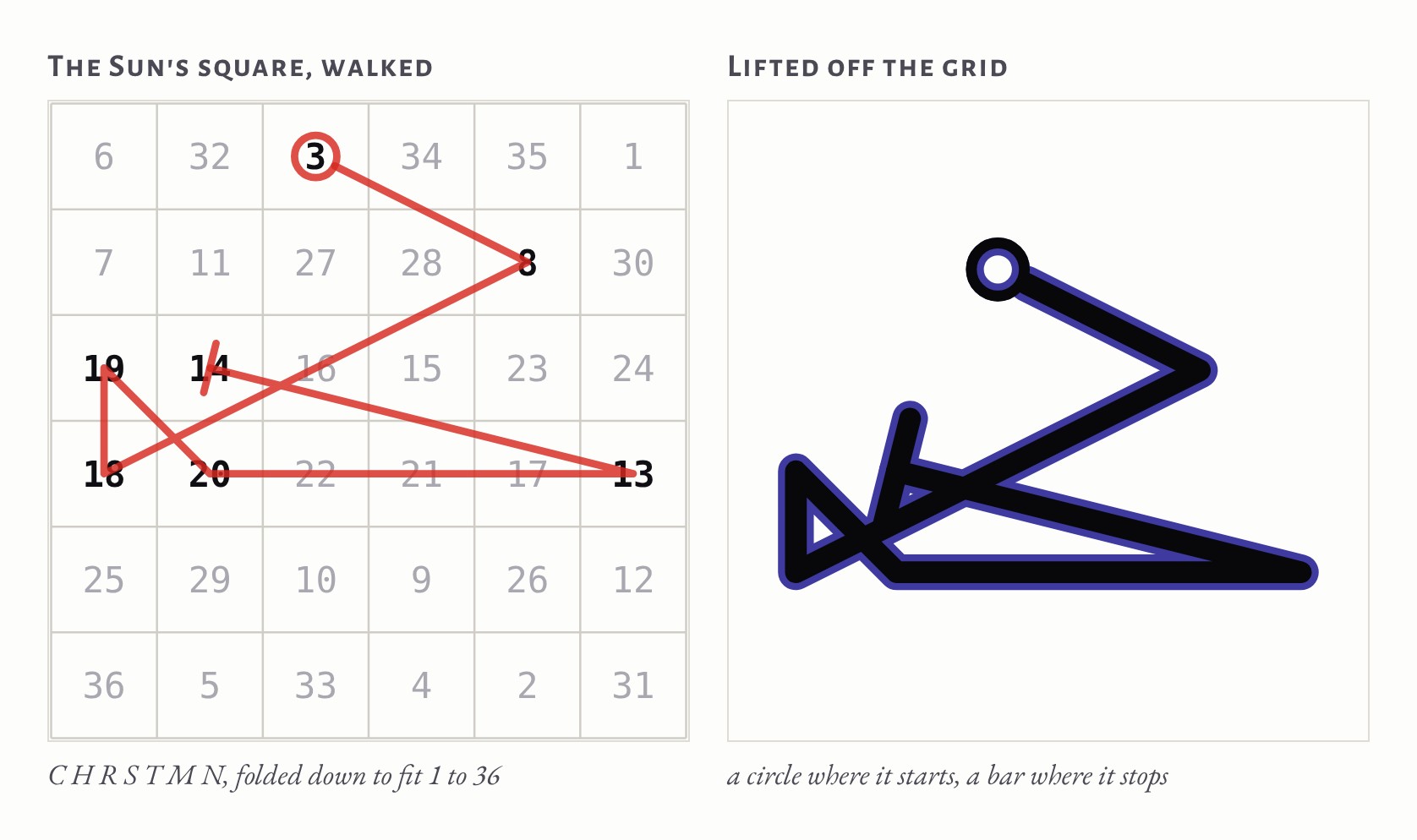
I was offered a memorial sigil and told Claude to leave it up to chaos. Claude took that as a job for a die, the way Pete would have you roll for a worldview. A computer rolled a seven-sided die and it came up 4: the Sun, the planet for health, success and being seen. For the words, Claude used my toast, “Cheers to the man”. From there it is arithmetic, and anyone can check it with a pencil:
- Strike the vowels, then the repeats. CHEERS TO THE MAN loses its E’s, its O and its A, then the second T and the second H. What’s left is C H R S T M N.
- Turn letters into numbers. A is 1, B is 2, all the way to Z at 26. That gives C 3, H 8, R 18, S 19, T 20, M 13, N 14. The Sun’s square holds 1 to 36, so every one of them already fits. On a smaller square you’d take away the square’s top number until it did.
- Walk the square. Find 3 on the Sun’s grid and put a small circle on it. Draw a line to 8, then 18, 19, 20, 13 and 14, in that order. Put a short bar across the end at 14.
- Lift it off. Draw just the line, without the grid. The circle says where it starts and the bar where it stops, so it can be walked again.
Same words, same square, same line, every time. The Sigil Oracle, which drew it, is dedicated to him.
Sources
- Pete Carroll, 1953–2026, the Illuminates of Thanateros, British Isles: his death, the order’s early years, “If it works, use it”, no astrology.
- Remembering Peter J. Carroll, Julian Vayne: the man himself, Pratchett and octarine, the miniatures, the apothecary, the druids, the goat.
- Peter J. Carroll, Wikipedia: dates, The New Equinox, stepping down, Maybe Logic Academy, the books, hypersphere cosmology.
- Chaos magic, Wikipedia: Sherwin, the dice, the last astrologer.
- Rebel Physics and the Chaos Magic Equation, Tetragrammaton: the equations and Dean Radin.
- Peter J. Carroll, Liber Null (1978): the laughter line.