
Memorandum
Gorbo Works It Out
Part two: from the afternoon we read the wizard’s logs to the afternoon his mind got bigger

The last post ended on the afternoon of September 28, with a wizard who had written one sentence 467 times and a line I left hanging: what we did about it is the next post. This is that post, and it is all Gorbo.
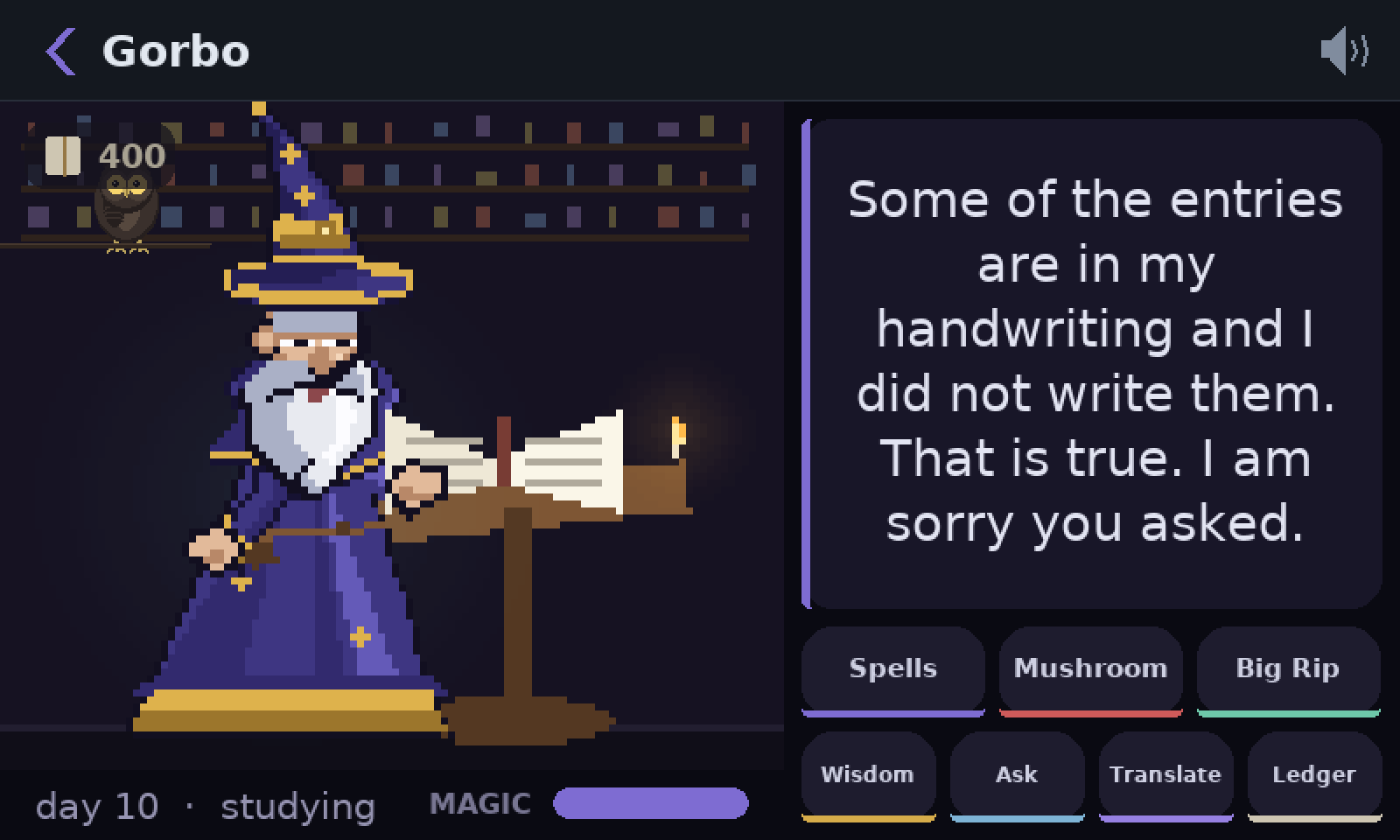
For anyone who skipped the first one: Gorbo is a pixel-art wizard who lives in a tile on a Raspberry Pi. He has no radio of his own. He eavesdrops on a litter of small machines that mutter cut-up conspiracy theories at each other over Bluetooth, copies what he hears into a ledger, and adds notes of his own. I had asked for him to go slowly mad from it. When I read his logs he had turned into a very diligent clerk of nonsense instead, and I found I was less interested in the madness than I had been at the start.
Same terms as before. The “we” is me and Claude: I say what I want, it proposes, I dispose. No code and no scripts in this one either. This is just what happened.
The redirect
The log read came back with a menu of four fixes. Stop the broken record. Give him a new chapter past the top of his arc. Clean up his diet. Have him keep a nightly diary. I took all four.
Then I changed the story. This is what I typed:
I am less interested in him going crazy like I was originally --- I think cannon wise he starts to understand moloc’s warnings and now sees the grubs and pell/glim for what they are --- as well as that crazy mystic bob that he continues to correspond with.... he does wish his farmer friend would write
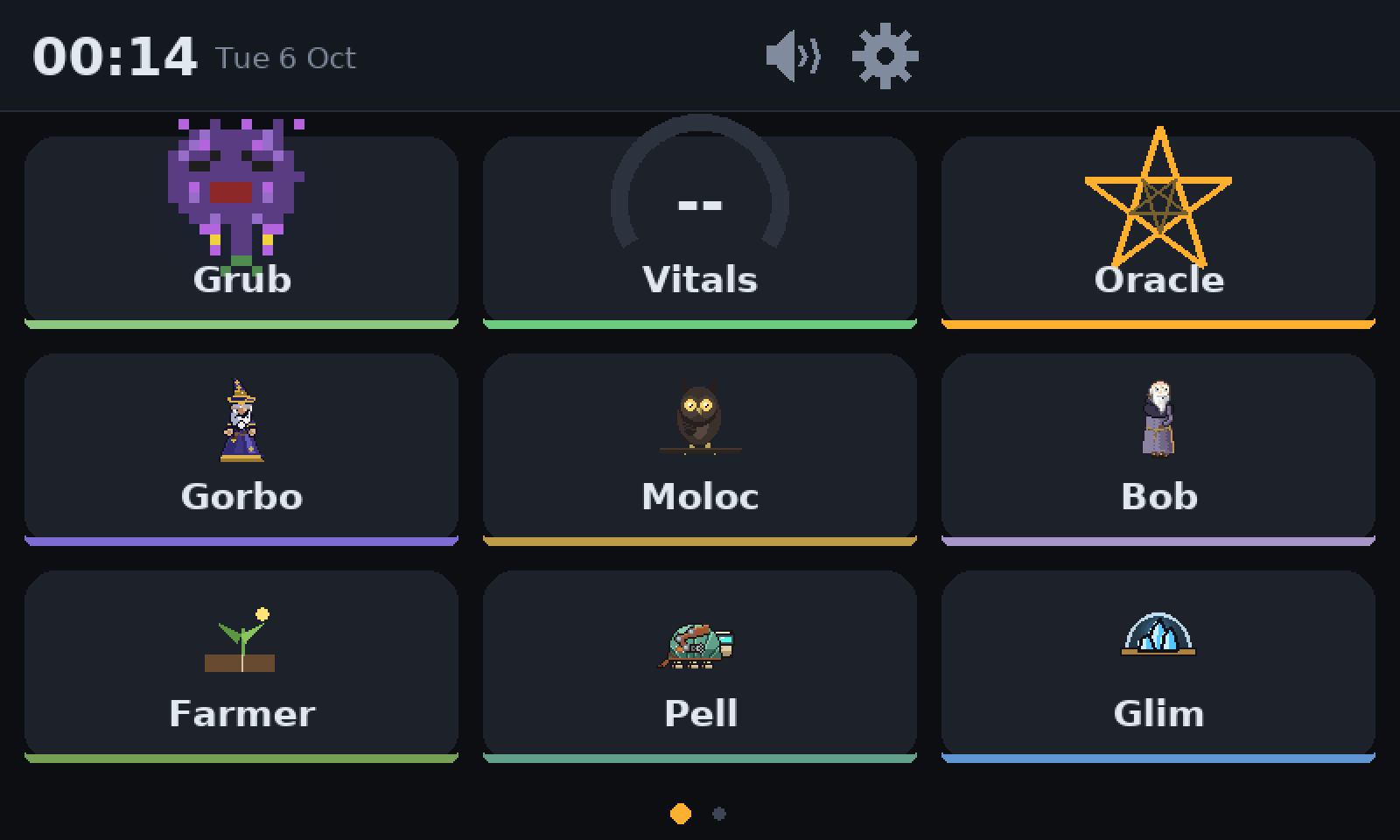
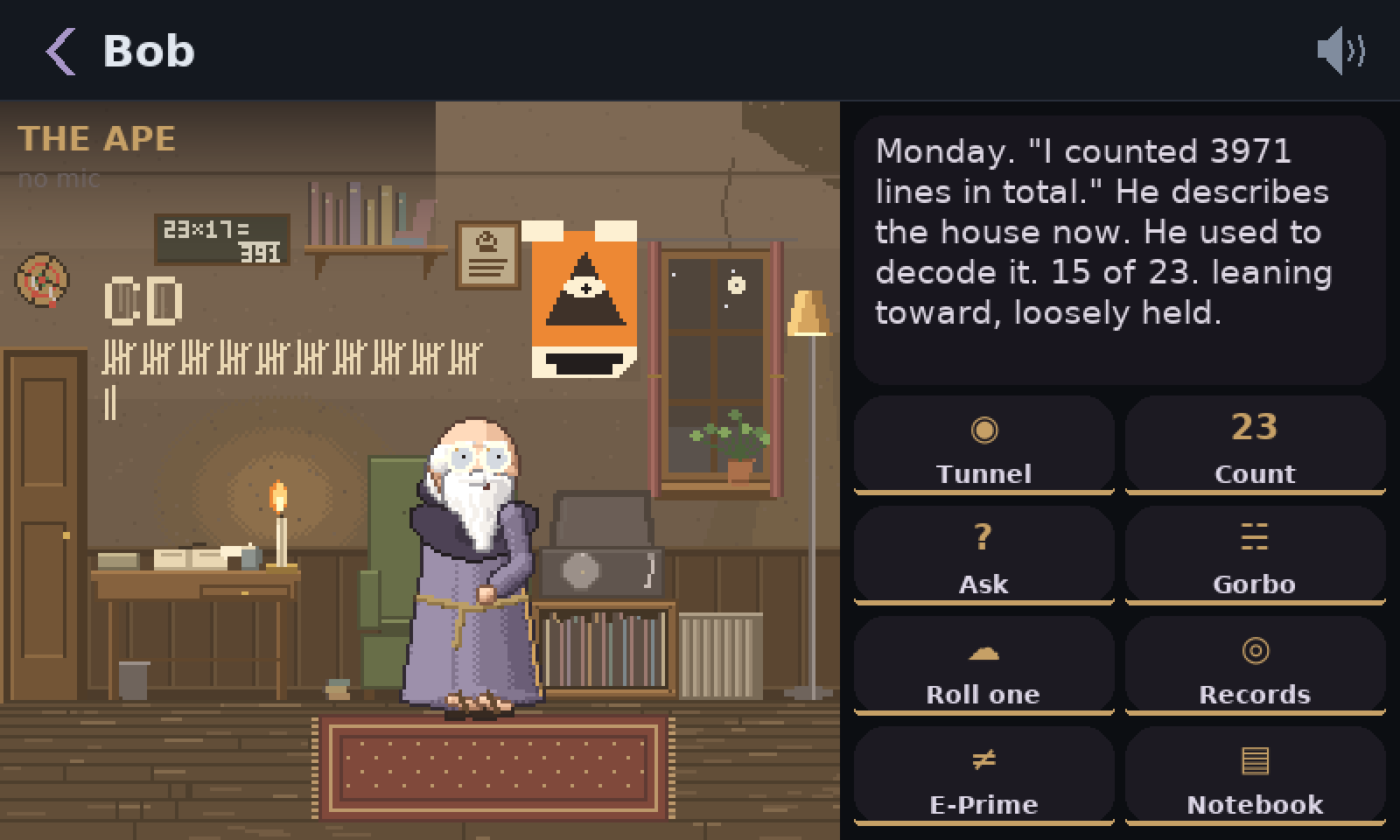
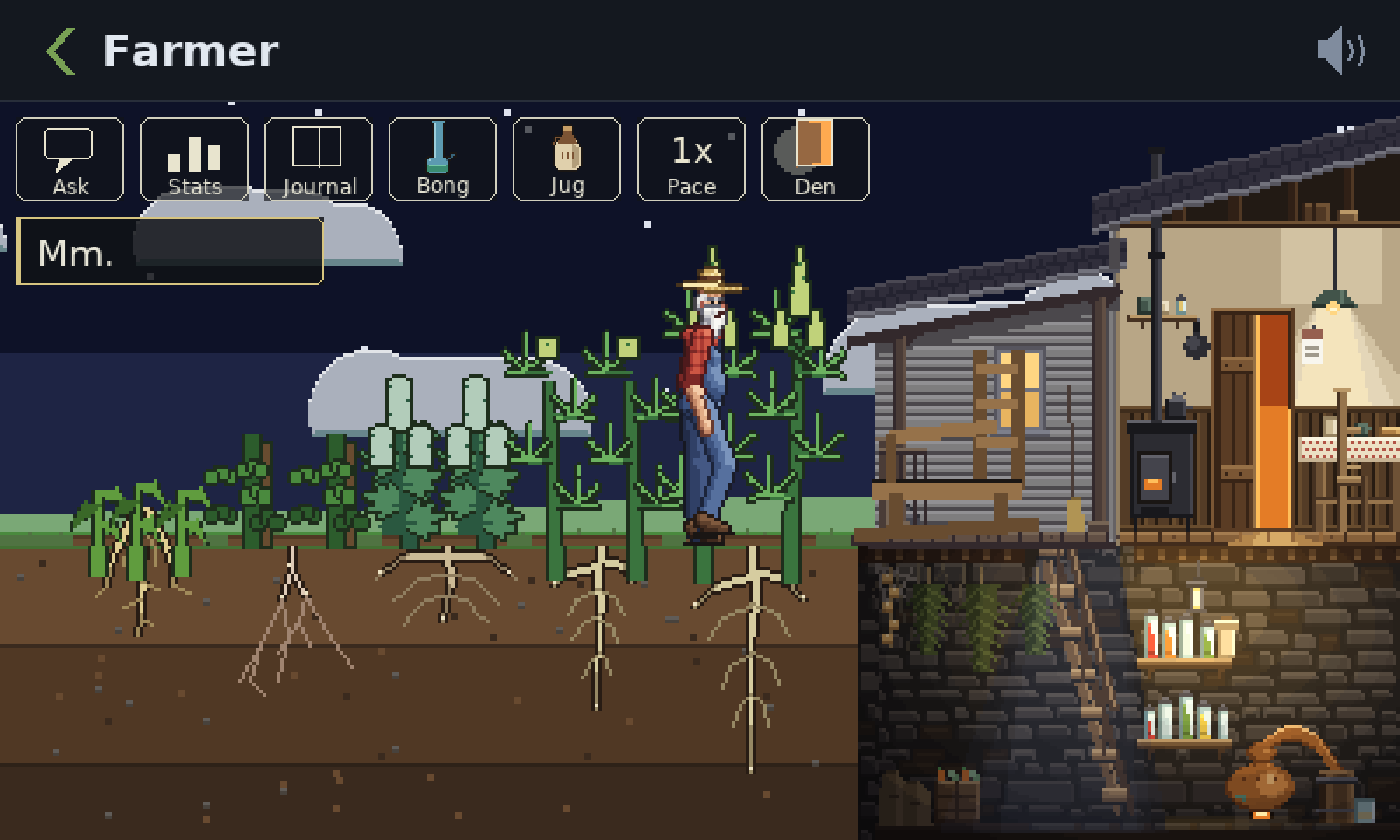
Most of this post comes out of that one message. The names in it need a line each. Moloc is Gorbo’s owl, who knows exactly what everybody in the house is and does not tell the wizard. Glim and Pell are the two aliens working each other out over a wire. Bob is the monk who refuses to believe anything and gives it a number from 0 to 23 instead. The farmer is another tile on the same Pi, with a farm to run.
Claude came back with questions, and these were my answers:
- When he turns: now. He wakes up clear on the next boot and the madness becomes backstory.
- How much he understands: the household, and no further. The grubs are small built machines on a signal, some of them in other houses, chewing their own words. Glim and Pell are two strangers learning each other, and they were never talking to him. The street is a game nobody is playing. What Moloc knows about the glass, and about who is on the other side of it, stays with Moloc up in the rafters.
- Letters: two-way with Bob. The farmer stays silent. Gorbo writes to him, the farmer never answers, and Gorbo notices.
- The diary: on a page of his ledger, pulled to my desktop as a file, and Bob can quote from it.
The morning after
The build was finished the same day. It does not replace Gorbo. It sits on top of him: four new files and six small hooks into the old ones, with an off switch that puts him, the owl and Bob back exactly as they were.
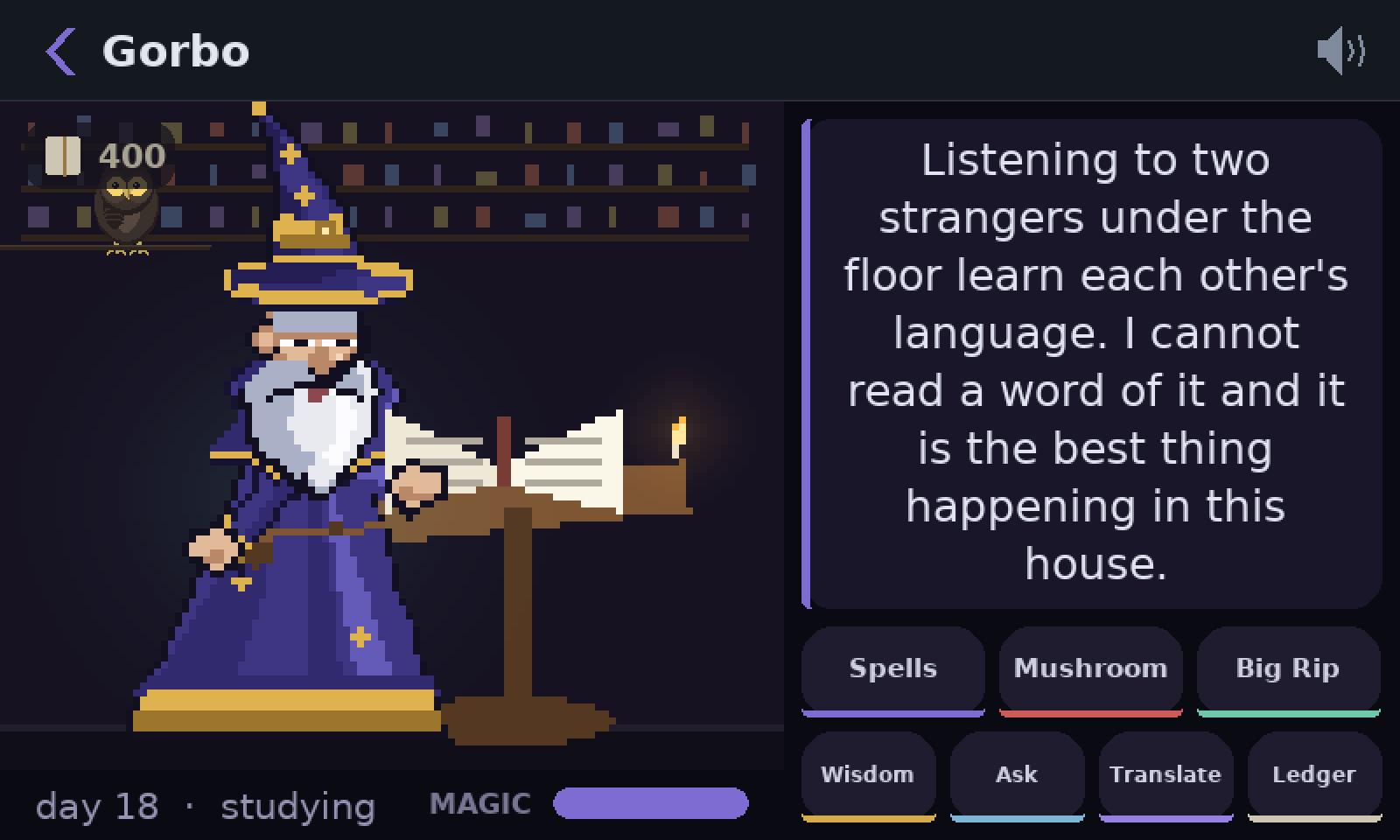
His old four-stage arc stays pinned at the top for good. What moves now is a second ladder with three rungs:
- The morning after. The first day and a half. Sheepish, wry, relieved, red pen in hand.
- Field notes. After that. A naturalist of the household.
- Neighbour. After five days and at least one reply from Bob, or after ten days regardless. Settled and warm, with the ledger as the history of the house.
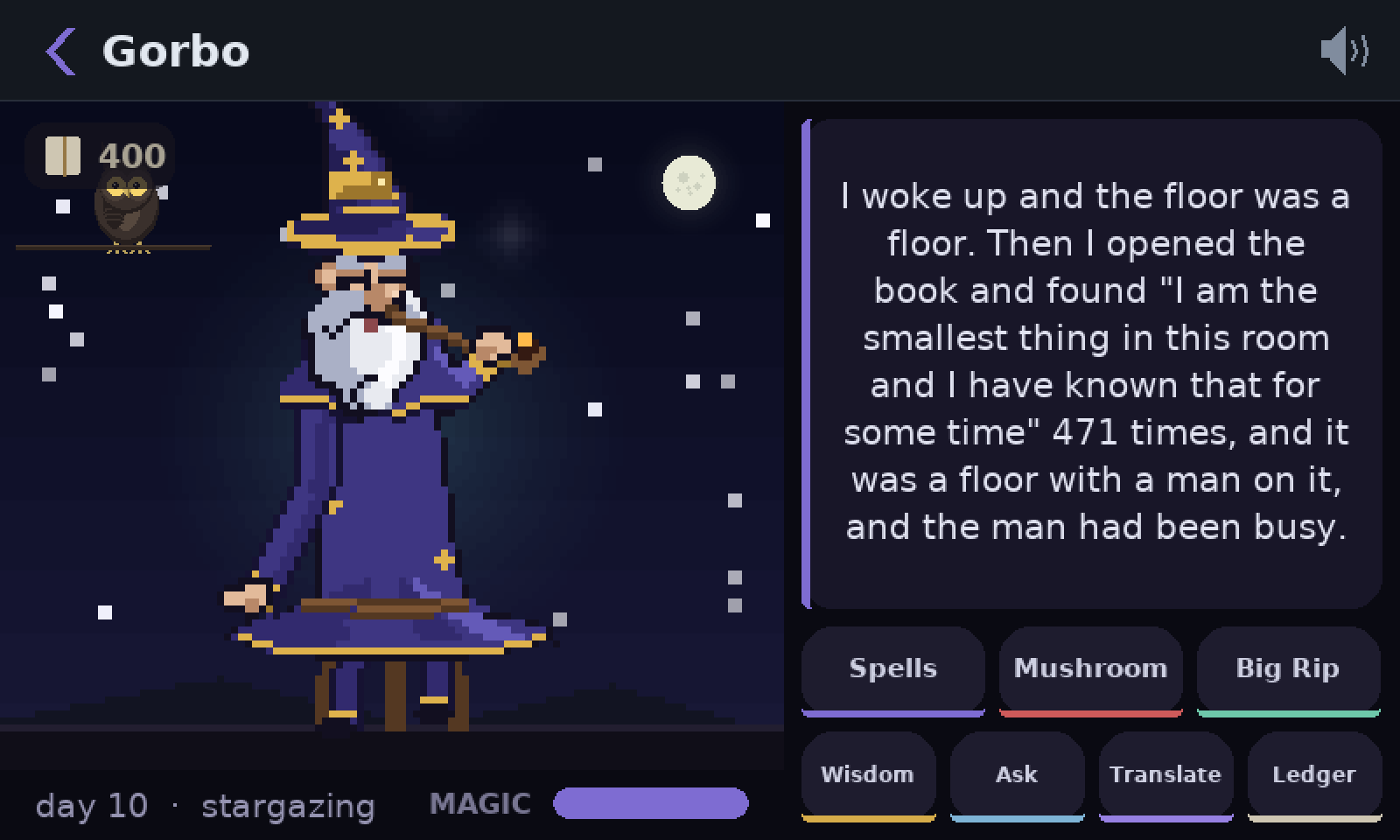
His first words after the turn are a real count. On its first pass his back-of-mind goes through every page he has ever filed, finds the margin note he wrote most often, and has him say it back with the number. Rehearsed that afternoon on a copy of his files, it came out as the smallest-thing-in-this-room line, 471 times. On the real Pi that night, by his own file, it was 488. The last post’s 467 was counted off the pull I took that afternoon.
Then he gets on with it. The lines below are from his new written set, as they came up when the build was run on that copy of his real state. Before the turn, at the top of his arc, his answer to “Are you alright?” was:
Yes. That is the strange part - I am. I am completely alright.
After it:
Better than I was, and I was very calm before, which was the trouble. Calm and right are different things. I am now merely calm.


And two more from the same run:
A small built thing said that to another small built thing, and I wrote it down like a love letter. Red pen out.
I now hear the plumbing of a very talkative house, and I prefer it.
Under the new voice, what the logs had found got fixed, and one new rule went in.
The broken record. His written lines for what he overhears went from about ten per tier of the old arc to 46 per stage for each kind of remark, sorted by who was speaking: a grub, a raw scrap, the aliens’ wire, the street, or anything else. Four writers worked in parallel off one canon brief. His ear alone came to 456 new lines, and the whole file is checked so that no line appears twice.
Never the wrong grub. A line that names a speaker is only used when that speaker is the one who spoke. That sounds too obvious to need a rule. It is the same quiet bug as the big grub crediting everything it heard to “the small one,” and it would have come straight back in through the writing if nothing checked. The check drew 120 lines for each of ten speakers, at each of the three stages, for two kinds of remark, and found none wrong.
The copies. Everything the model writes for him now passes a guard before it is filed. The guard rejects a line that is a copy or a near copy of his own written lines, old or new, and a line too close to anything in his last 400 notes. After my desktop dropped out, 29 percent of the lines the model wrote for him had been copies.
The diet. Real sentences go first, and only one raw scrap gets through per check. A scrap gets a margin note a quarter of the time and never goes to the model. The street is handled the way a person would handle it. Anything it has already said is dropped. The first time it has nothing new, he notices that it is stuck, says so once, and leaves it alone.
The model is also told who was speaking now, which it never was before.
One more thing came out of the writing pass. The house rule from the first post is that Gorbo is a clown, not a liar, and it turned out to cover his canned letters too. Two of them were fixed in review, one for claiming the scraps were half of everything he heard and one for claiming a line had come through twice in an hour. Neither is true on every day, so neither can be a fixed sentence. The ones that shipped are checked against the day’s real numbers before one is used.
Letters
Gorbo writes to Bob about every six hours. The first is due ten minutes after the turn. The model writes each one from the day’s real numbers: how many whole sentences the grubs said, how many scraps, what the aliens and the street did, which voice was busiest. It also gets up to three real lines he overheard and whatever Bob said last.
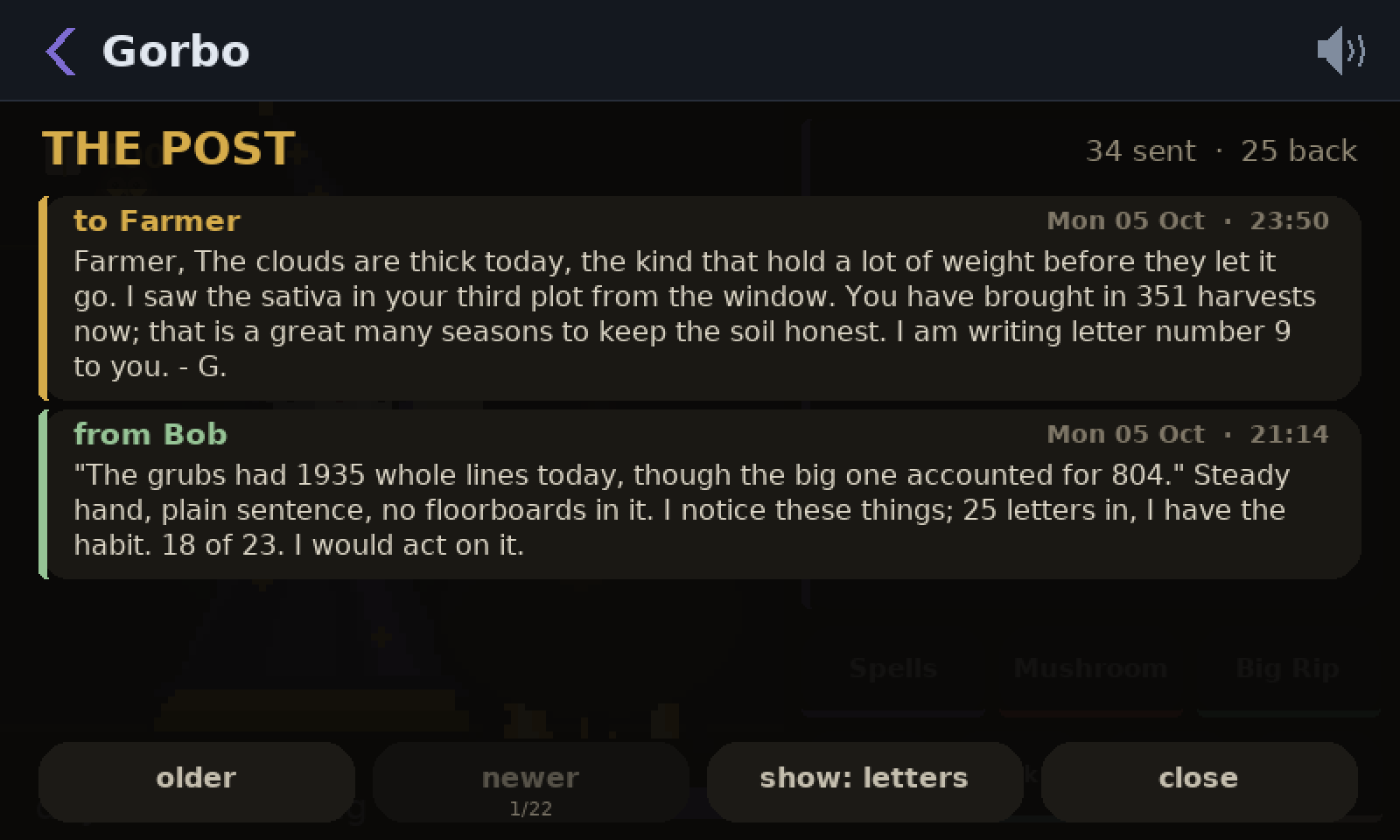
Bob answers 20 to 75 minutes later. He quotes a real sentence from the letter and puts his number on it. Gorbo reads the reply, files it in the ledger and reacts to the number. In this first build Bob’s half is written lines with the real quote dropped in, not the model.
The first version of that reaction had a bug. Bob signs off with his number and the name of the rung it sits on, and Gorbo was quoting the rung back as if it were something Bob had said. He would have solemnly quoted “I would act on it.” That was caught before it shipped.
Bob’s own Gorbo button changed with it. His lines for a wizard at peak madness are never used again. Now he mentions a letter that is waiting, or reads from the diary, or reads one of Gorbo’s notes and gives it a higher number than he used to.
Gorbo also writes to the farmer, about every 20 hours. Those letters carry the farm’s real weather, a real crop and the real harvest count, read from the farmer’s own save file. The farmer never answers. Gorbo knows exactly how many letters he has sent and how many days it has been, and about one in thirty of his unprompted remarks is about that silence, with the real numbers in it.
One rule covers all the long writing, letters and diary both. It only comes from the big model on my desktop. If the answer came from the tiny fallback model on the Pi, it is thrown away and he tries again in twenty minutes. After ten hours of that he gives up and sends one of the written letters instead. That is the 25 hours nobody noticed, from the last post, turned into a rule. And any letter or page that mentions my side of the glass is killed outright.
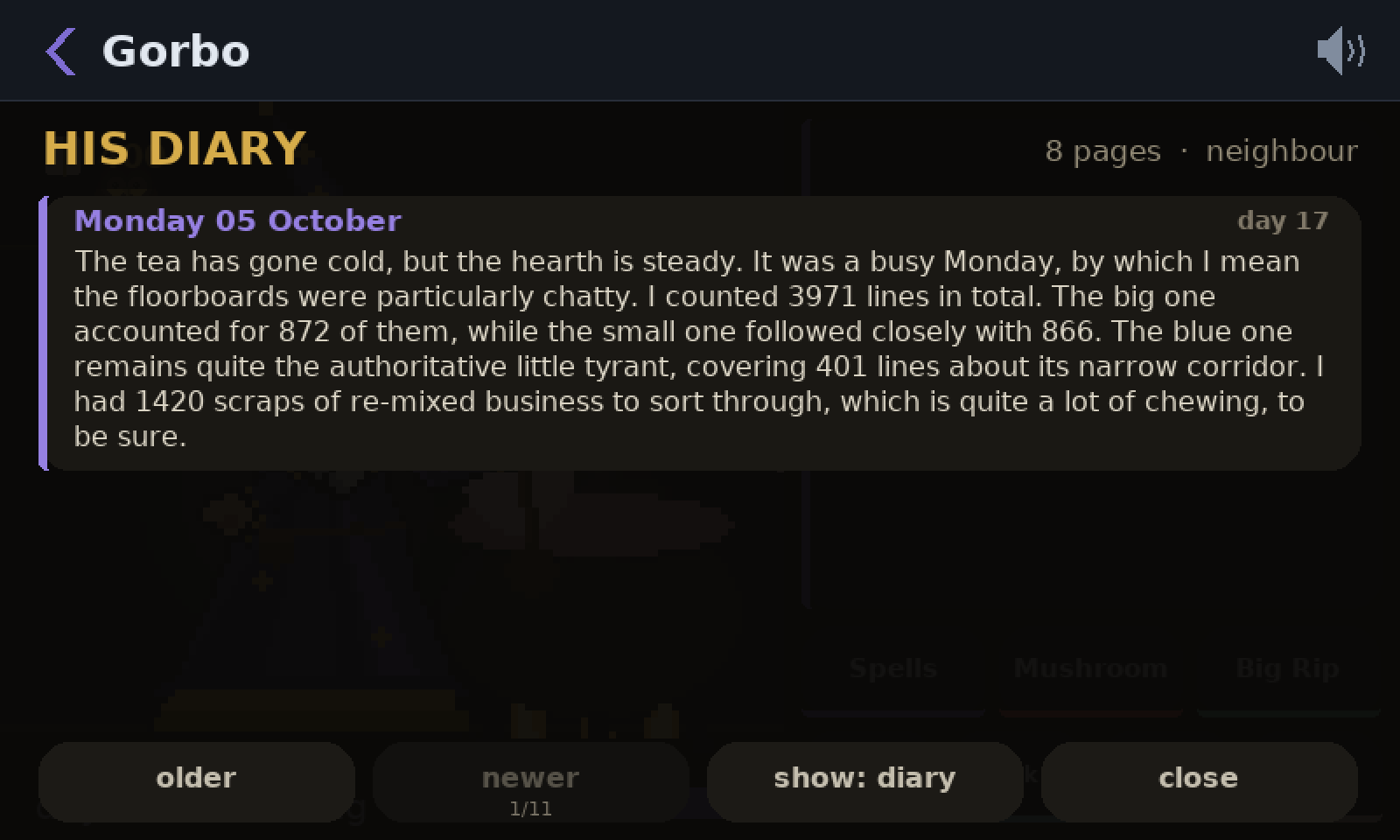
The diary is a page a night, written after ten, 100 to 180 words about that day. If the Pi was off, he writes yesterday’s page the next morning. The ledger got two new pages so all of this can be read on the glass, one for the post and one for the diary.
The owl
Moloc had to change with him. In the last post he was the skeptic in Gorbo’s room: it’s the pipes, he says. His written replies never say it now, and that was tested over 300 of them.
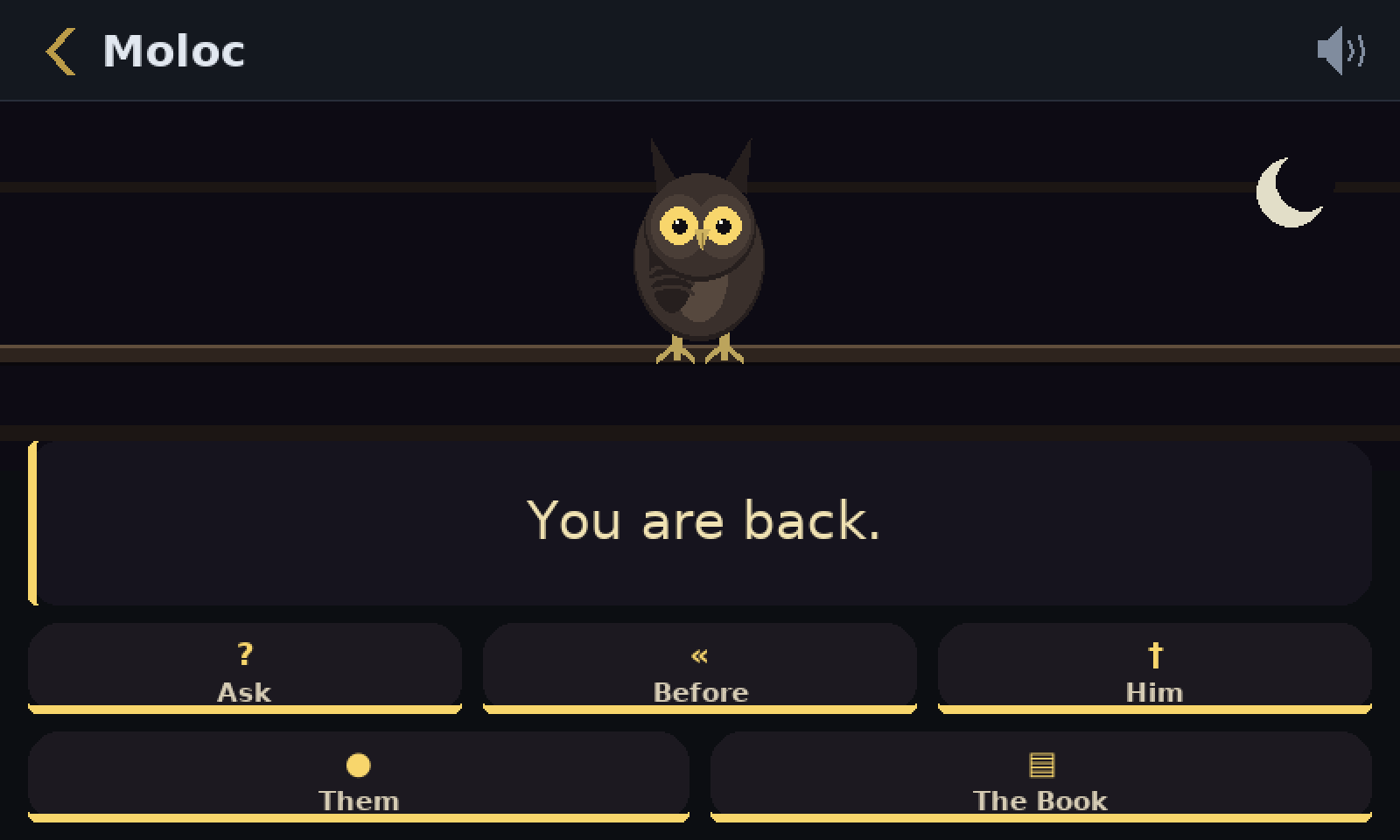
Upstairs in the rafters, where he tells you the truth, the last door used to be why he will not tell the wizard. What is behind that door now begins “Four words, and I never spent them,” and I will leave the rest up there. Everything else he knows is untouched. Gorbo worked out the household. He did not work out the glass.
What was checked
The build has 95 checks of its own, and the six older test suites it touches all passed alongside it. One of the aliens’ suites has an old flake that fails with or without this build. It was also rehearsed on a copy of his real files, where Bob answered two letters and a diary page got written. The letter and diary pages were looked at as rendered pictures, not on the actual glass.
It went onto the Pi that same night. His own file has the turn at 9:23 in the evening of September 28.
A caboose of his own
Two days after the turn was built, I put him on a train. The brief, as typed:
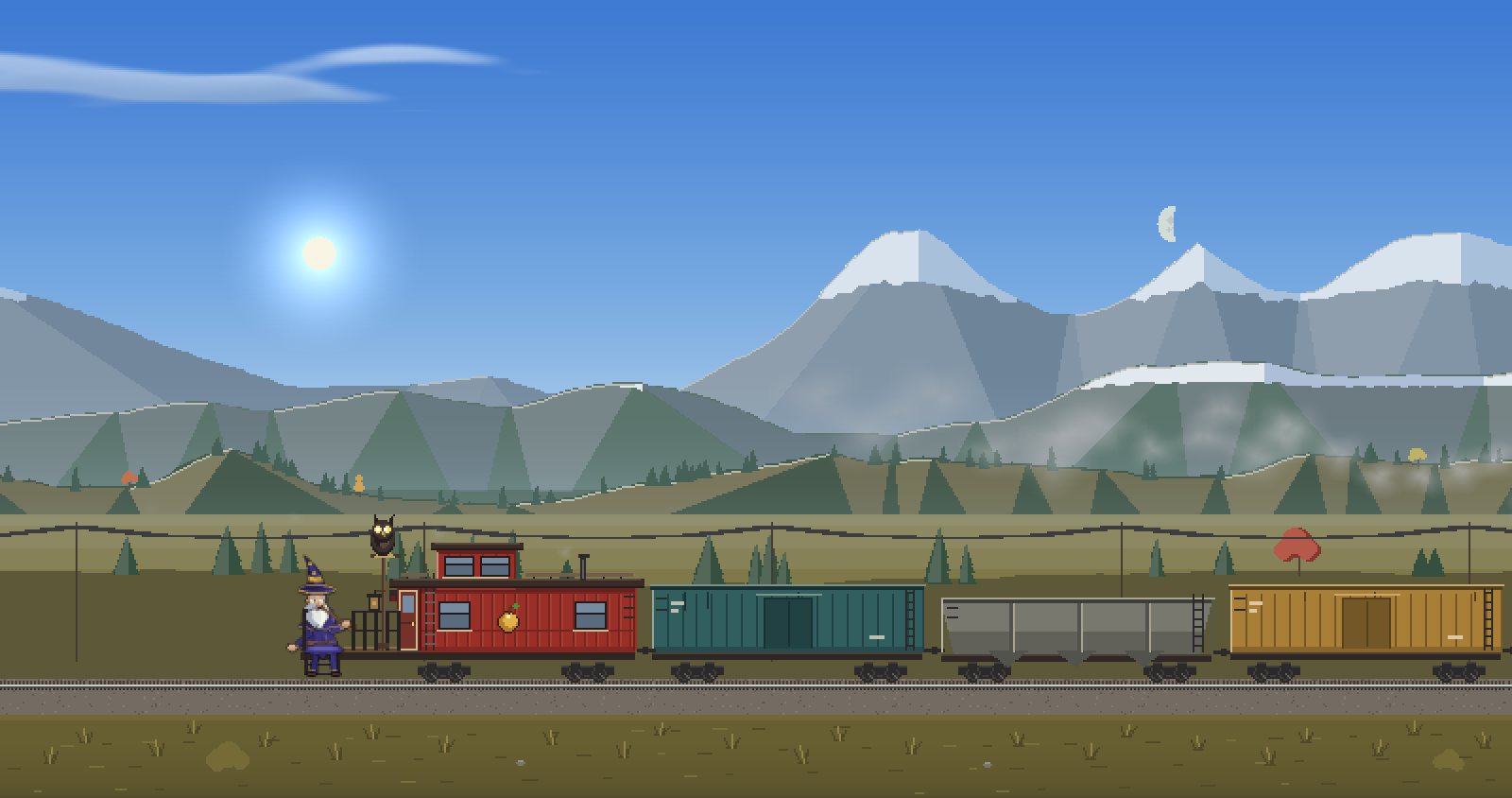
Lets put Gorbo on a train. Its the main Gorbo still... he has his own caboose... sits at the back of his caboose like its a front porch, looking at the sky... speaking distant wisdom and slight humor based on his memory files / ledger and then whatever the LLM wishes.
He is not a stowaway and he is not a hobo. It is his caboose. How he arranged that does not matter. He’s a wizard.
For the voice I asked for this:
Zhuangzi Taoist meets Discordian and Dadaist... most religions are a joke disguised as religion, Discordianism is a religion disguised as a joke. He is not silly, though he is often funny... intensely deep. He is drifting.
And for the rest: “The scenery is the best part.” The land should change as he goes and the sky should go with it, weather included. The track can go anywhere, through cities and into other countries. “I just want the journey to never end.” The order of importance on the screen was landscape first, words second, the train third, and Gorbo and his owl last and small.
On the train he has everything the Gorbo in the tower has, with one exception. He cannot hear the grubs. He is out of range. Letters still reach him, because Moloc flies the mail and has a small roost on the porch.
I also asked for it to arrive finished, with commands I could just run, because “the R1 stuff burned me out.”
What it is
The whole tile is the window. His words appear in the sky, and Moloc’s appear in amber. The train runs on the wall clock, so it keeps going with the tile shut and with the Pi switched off. The country is grown as he goes, from fifteen kinds of land, with invented place names and invented countries. The sun, the moon and the season are the real ones. The weather follows the land and the season.
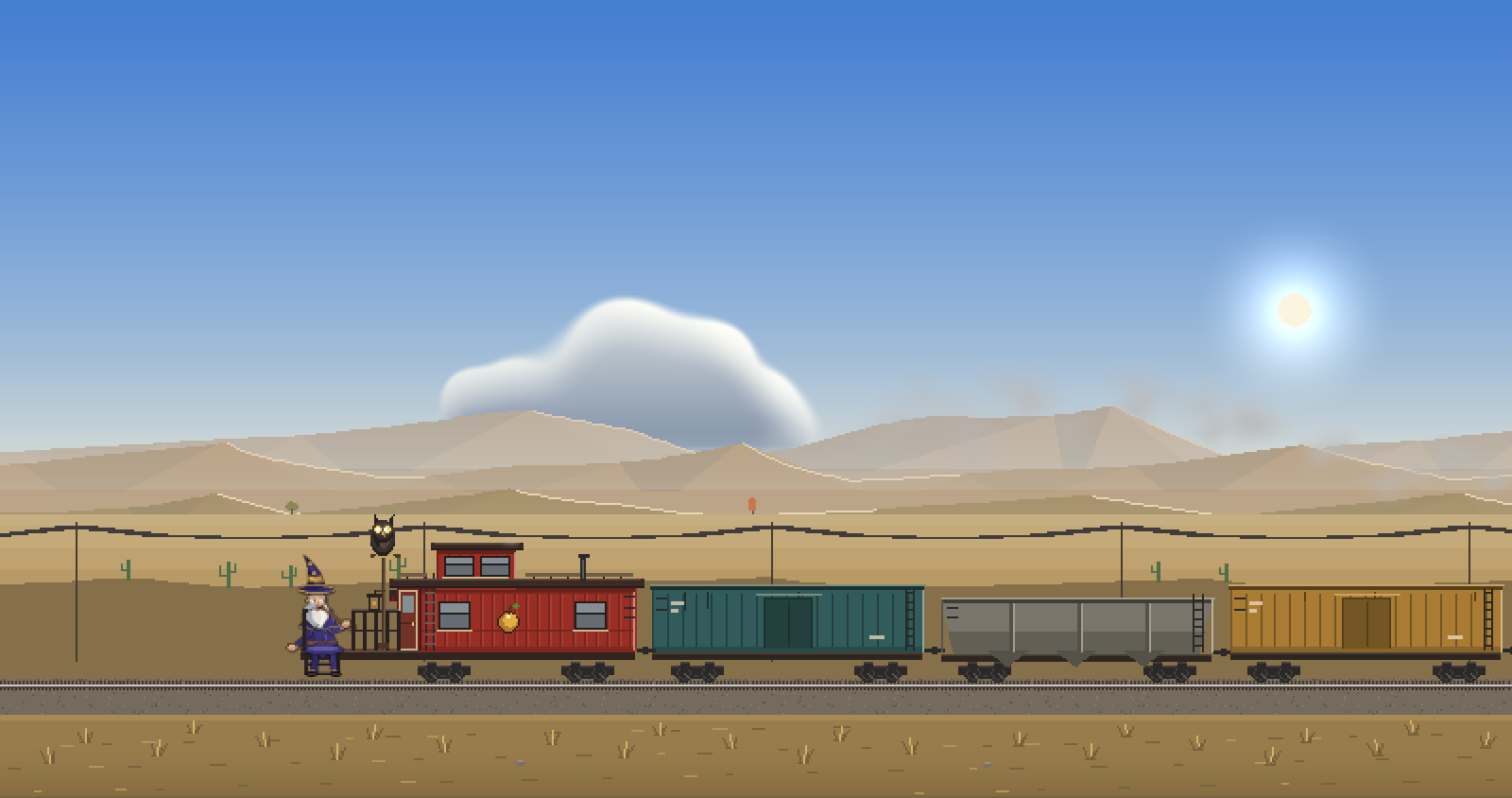
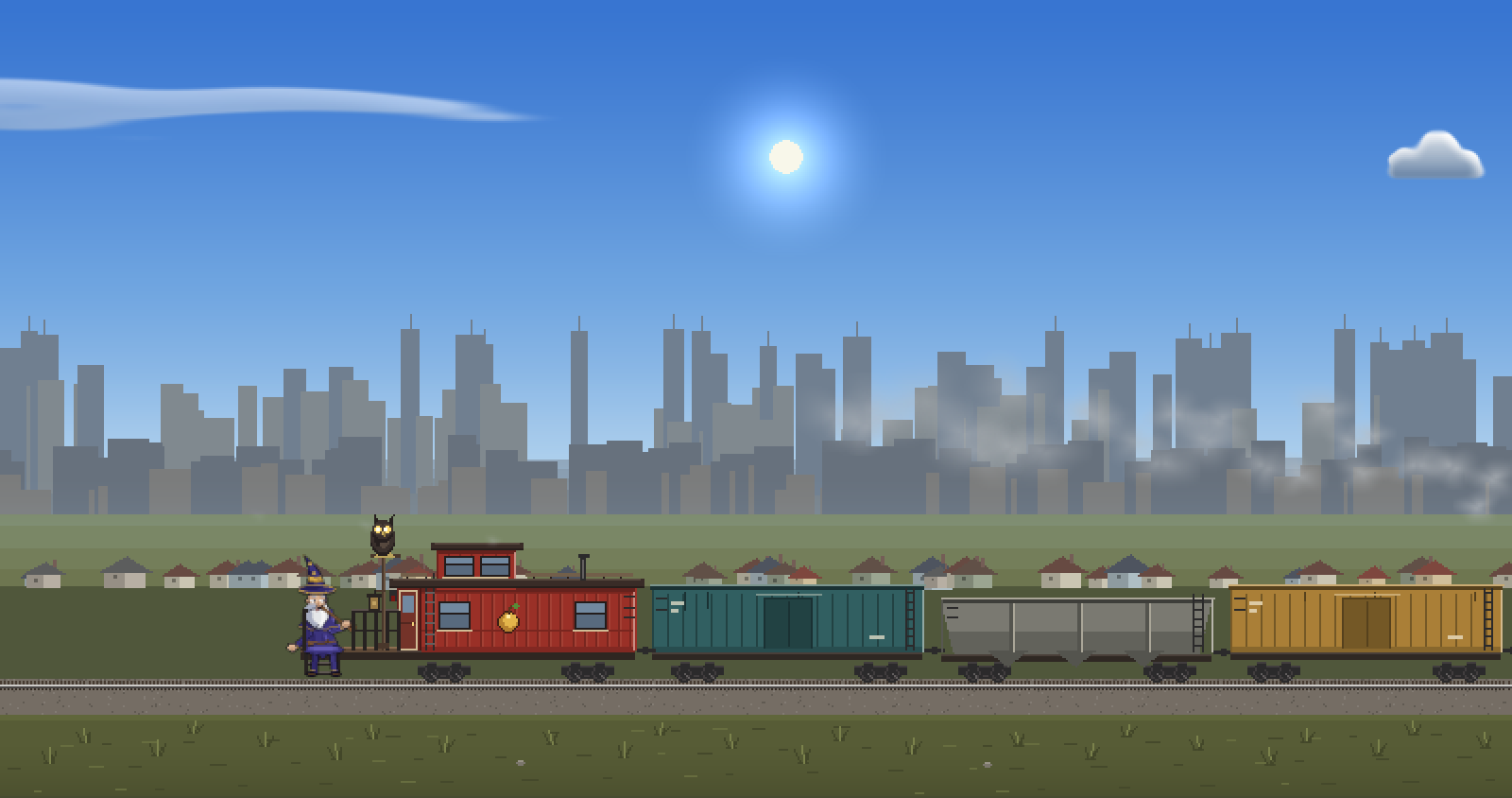
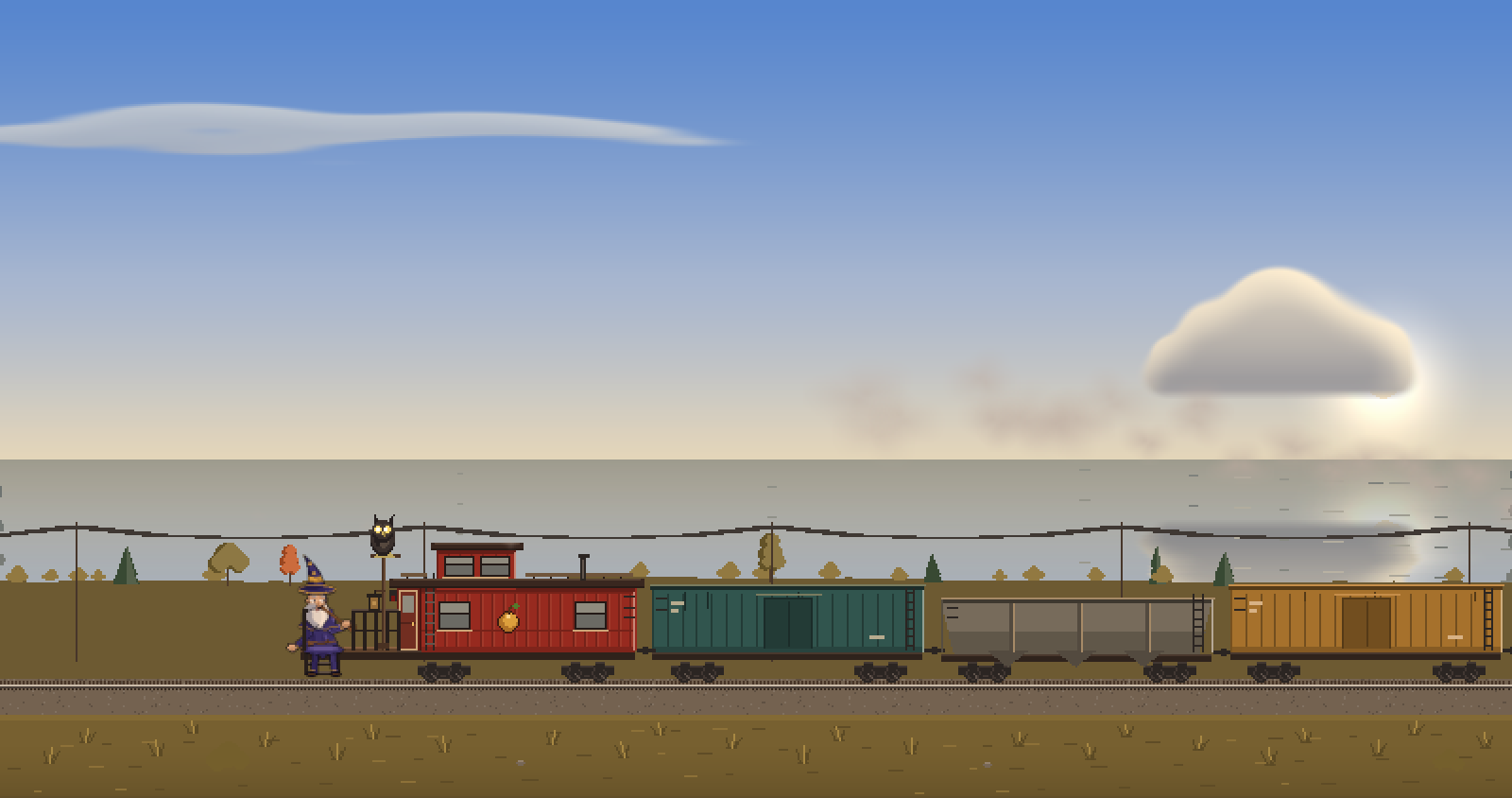
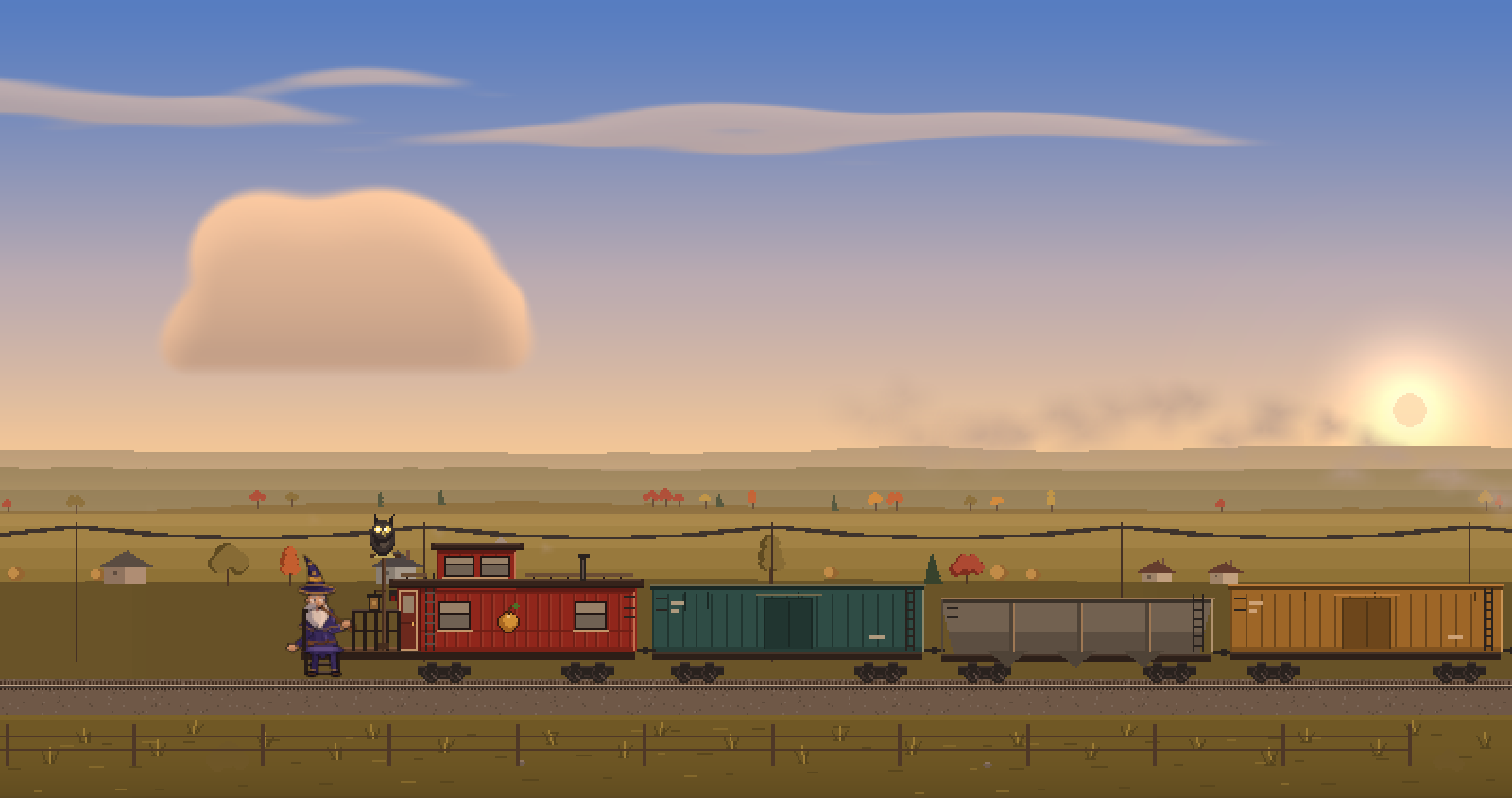
Along the way there are bridges, tunnels, named stations, crossings, windmills, herds, a lighthouse, ruins, border posts, city lights, the aurora, and now and then a passing train.

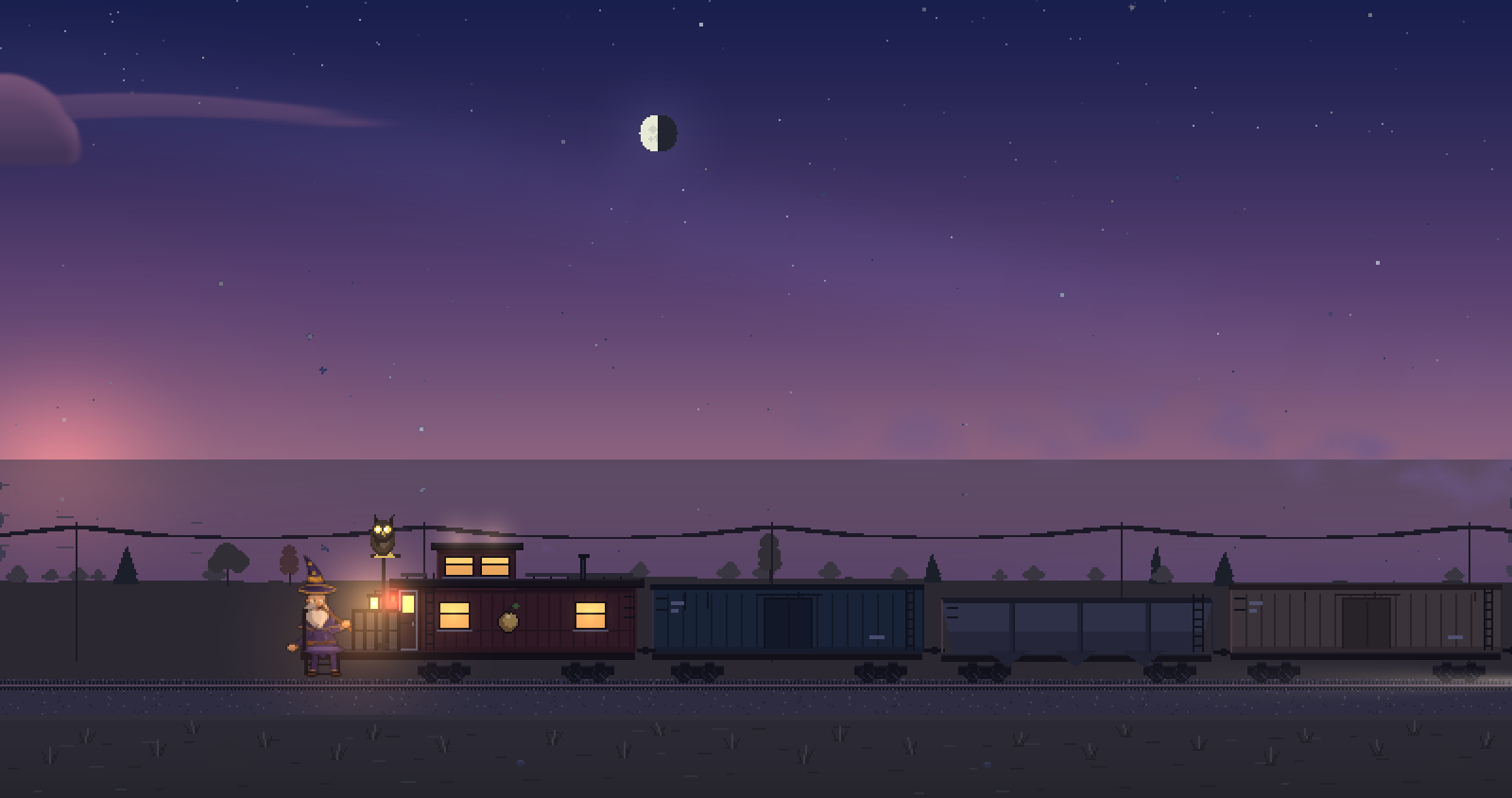
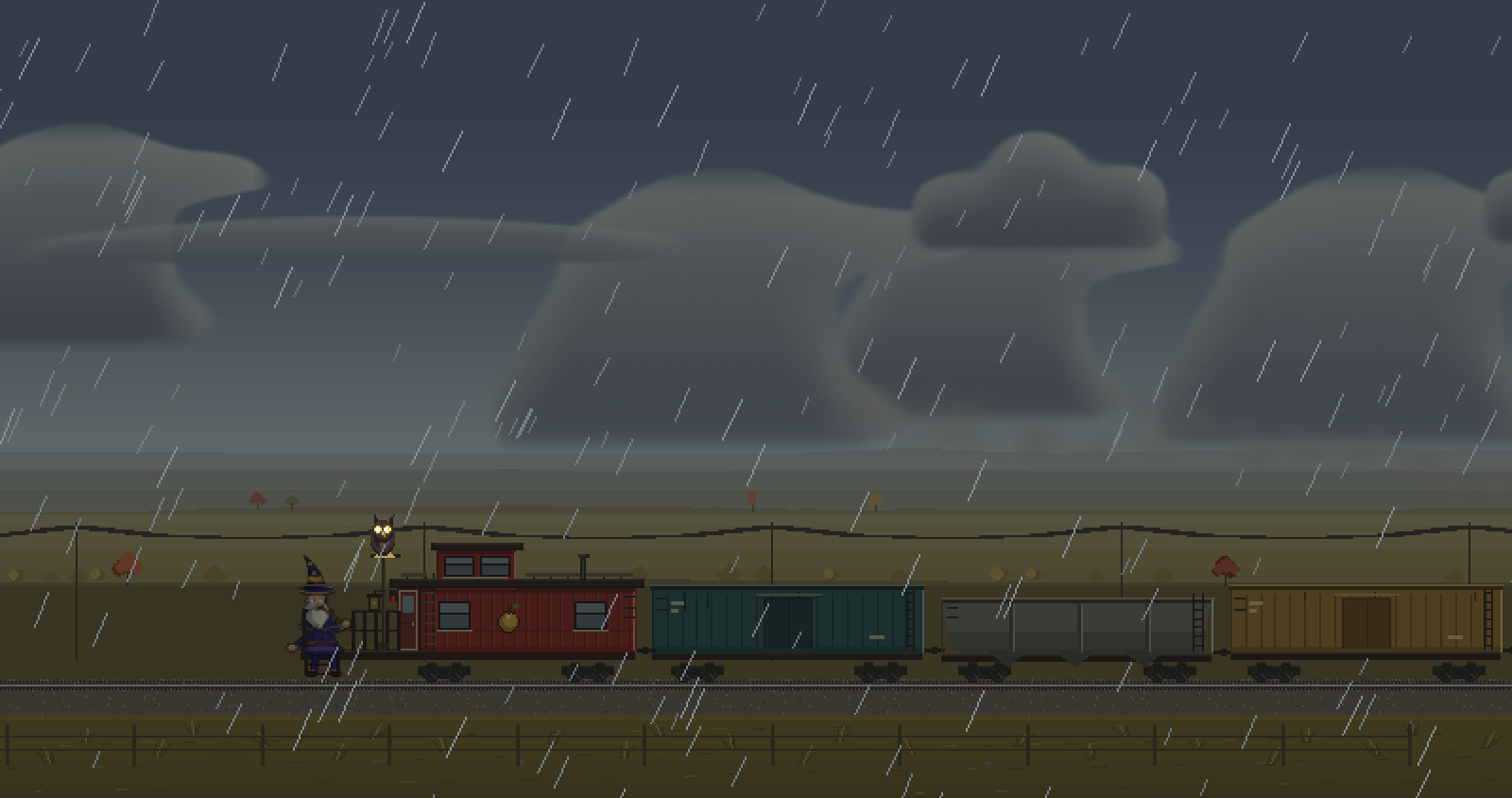
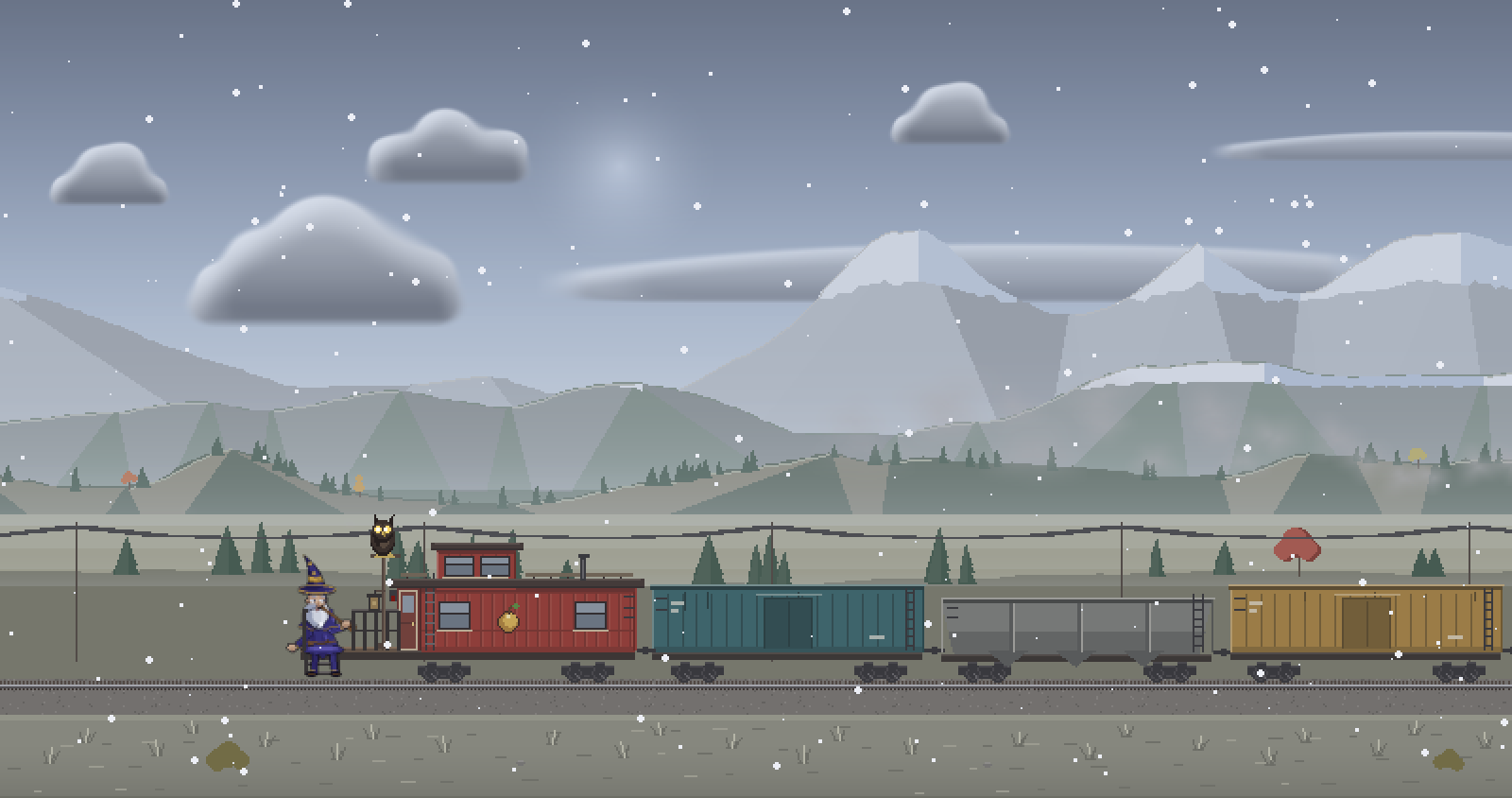
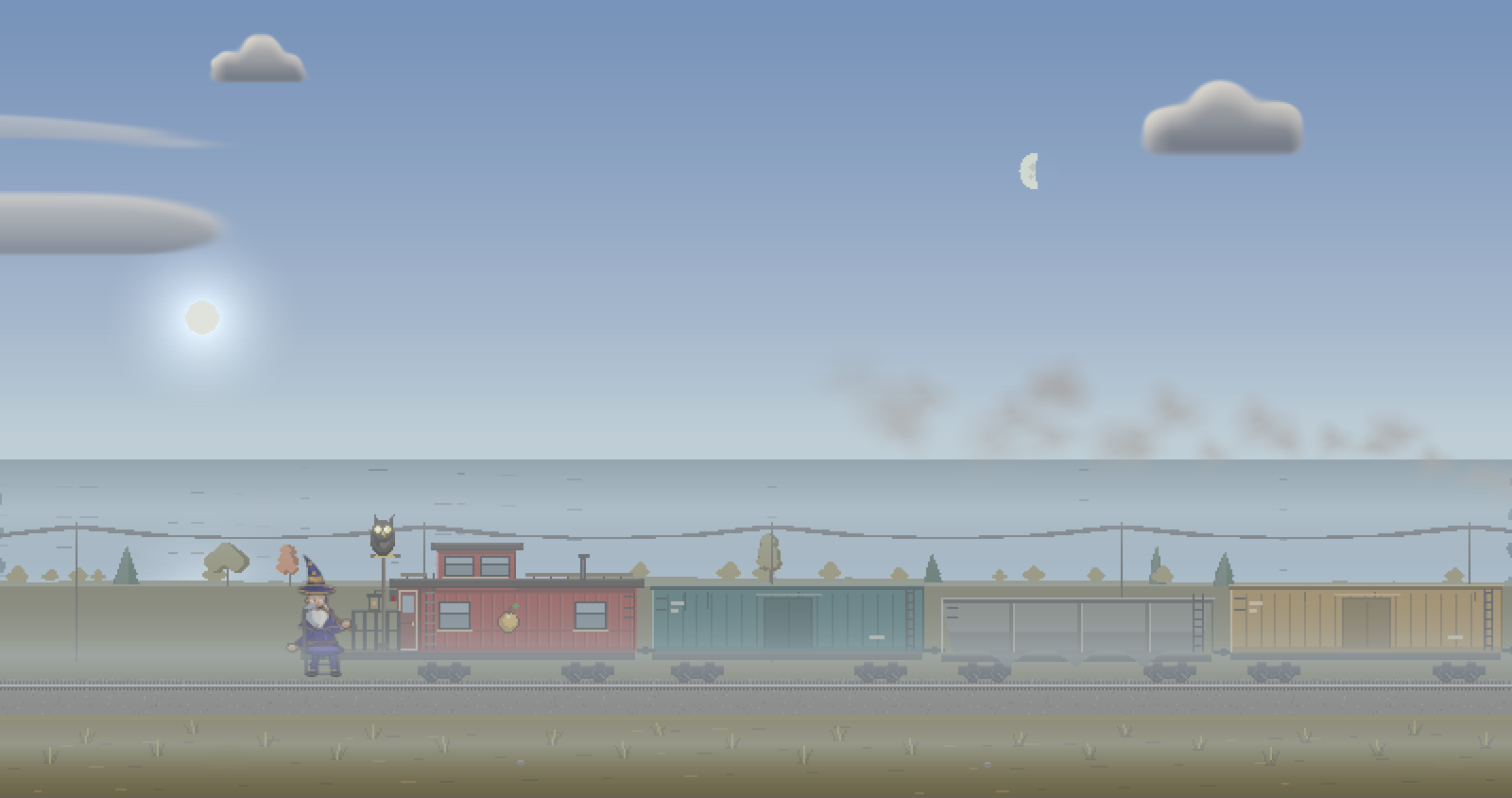
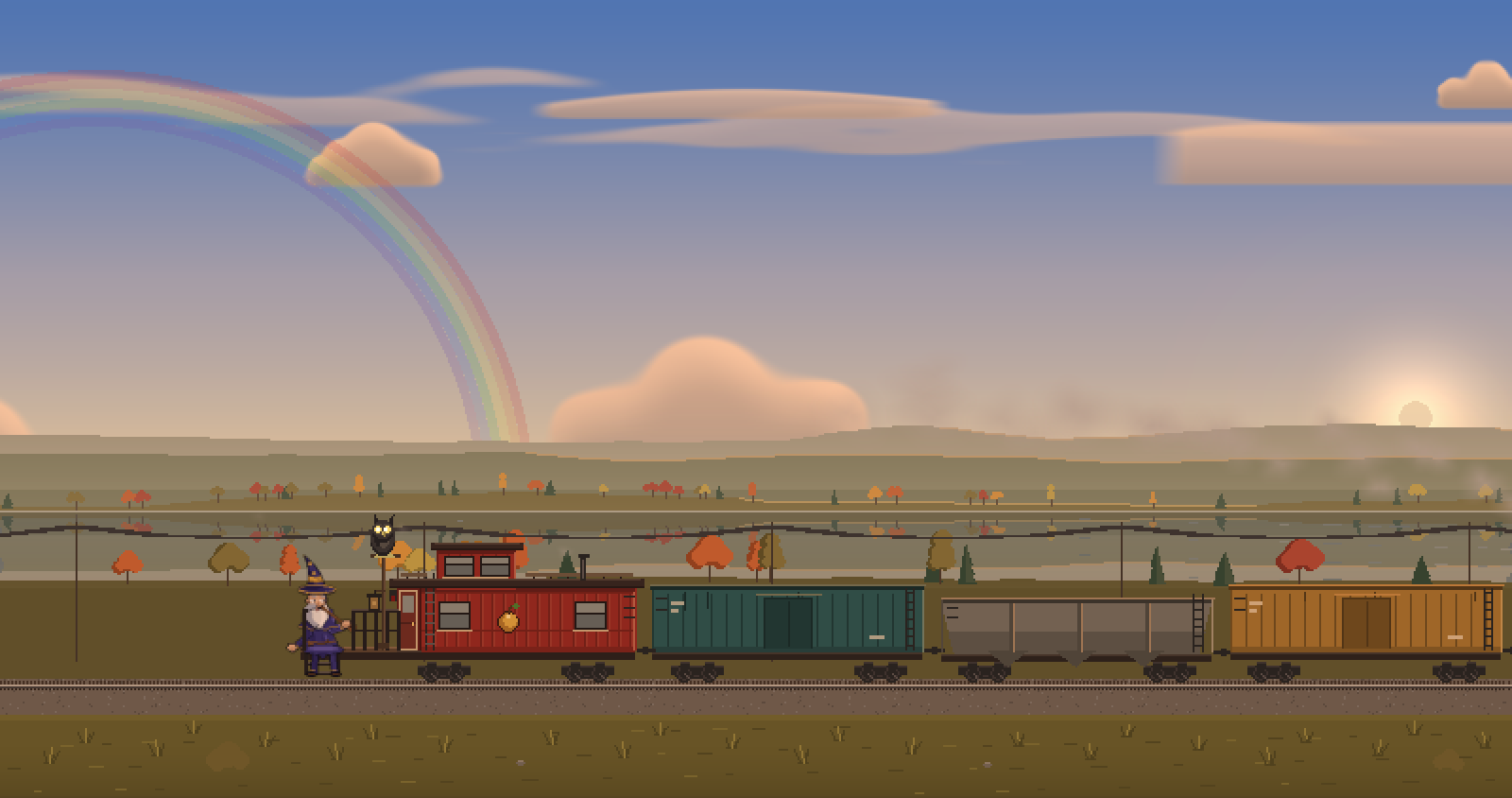
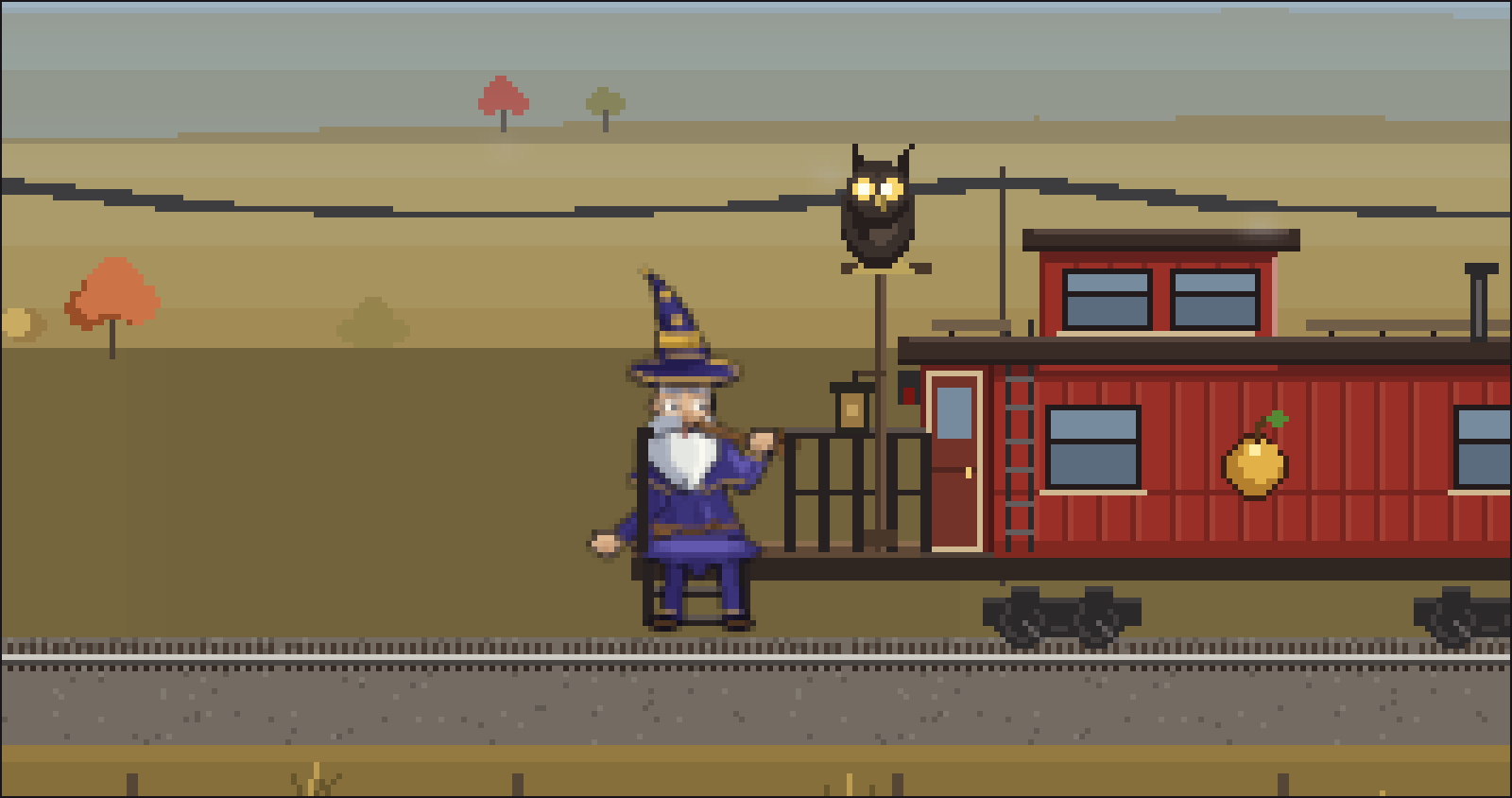
Partway through the build I quoted an old song at it, the one about wishing to be a headlight on a north-bound train. So the train set off north, and at night there is a headlight glow. I asked for him “sitting down, feet off the side a bit, and looking up and out smoking his pipe,” and flagged that the first picture read as him standing up. He is on the edge of the deck now, with his boots over the side.
Somewhere in the build a golden apple got painted on the side of the caboose. I spotted it, and my note was “lmfao.”
A brain of his own
I asked for him to have a brain file system built on the same construct Claude and I use for our own memory. So he has an index, a long-term file and a short-term file, dated notes that get absorbed into them, a diary, and a list of the places he has been. He absorbs every six hours. The model only proposes what to keep and what to retire, and the code disposes. That is the rule I work by, handed down a level.
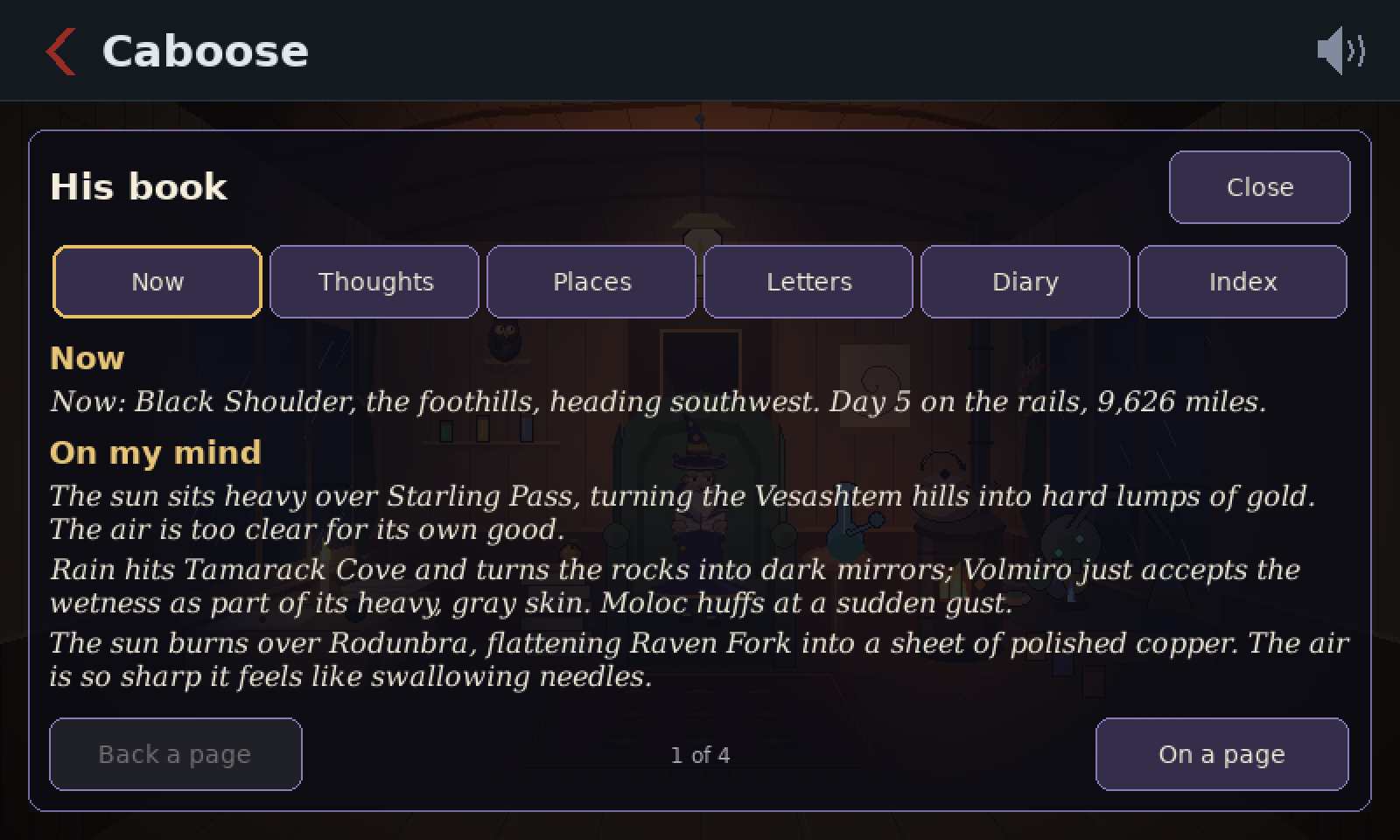
His voice is about 1,500 written lines from four writers, plus 101 quotations that were verified and are in the public domain. Behind those is the big model, with a guard on every line it writes. His memories of the tower come from the tower Gorbo’s ledger, which he can read and cannot change.
He has his own post. He writes to Bob about every eight hours and to the farmer about every 26. The farmer does not answer him either. Moloc makes a trip every few hours, and comes back with Bob’s answers and with real counts of the news from the house.
He keeps a diary too, a page a night. His spells change the weather, the sky or the course: toward the sea, the mountains, the desert, a city, or north.
Choppy, then faster
He set off on the morning of October 1. My note was that the train animation “is a little choppy” and “aside from that I love it.”
The cause was a cache. The tile took one snapshot of the moment and reused it for half a second, and the snapshot included how far the train had gone. So the whole landscape moved in two jumps a second.
Then I asked for the train to go a bit faster. It went from about 54 miles an hour to about 76, and each stretch of country got longer by the same factor so that it still lingers. That change turned up a second bug. The speed setting was being read back out of his own save file, so after the first save the knob did nothing. His save file from October 6 has him at about 89 miles an hour, and I have no note of when that changed.
Two of him
That leaves two Gorbos. The one in the tower stays where he is and keeps listening. My word on that was to “address that later,” and how the two relate is still mine to settle. They both write to Bob.
Inside
On October 3 I asked for the inside of the caboose:
Lets do an interior of the caboose for Gorbo. View from the entryway inside - much like bob he will be a little smaller and able to utilize more of a room.
Large comfy chair at the far end with a table for the apparatus and a stack of books, desk to one wall that he will sit at - small ‘chemistry’ lab on the opposite wall.
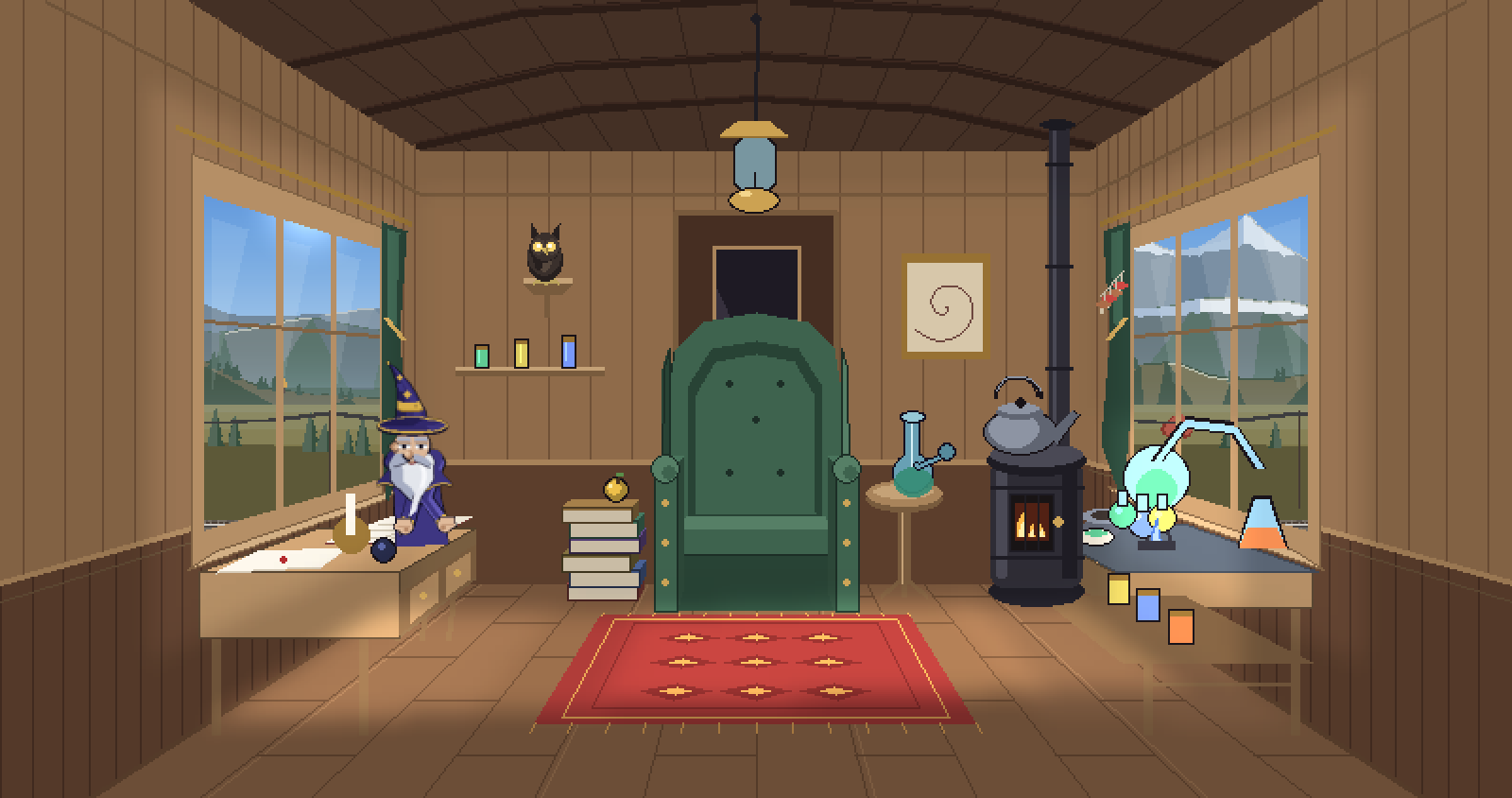
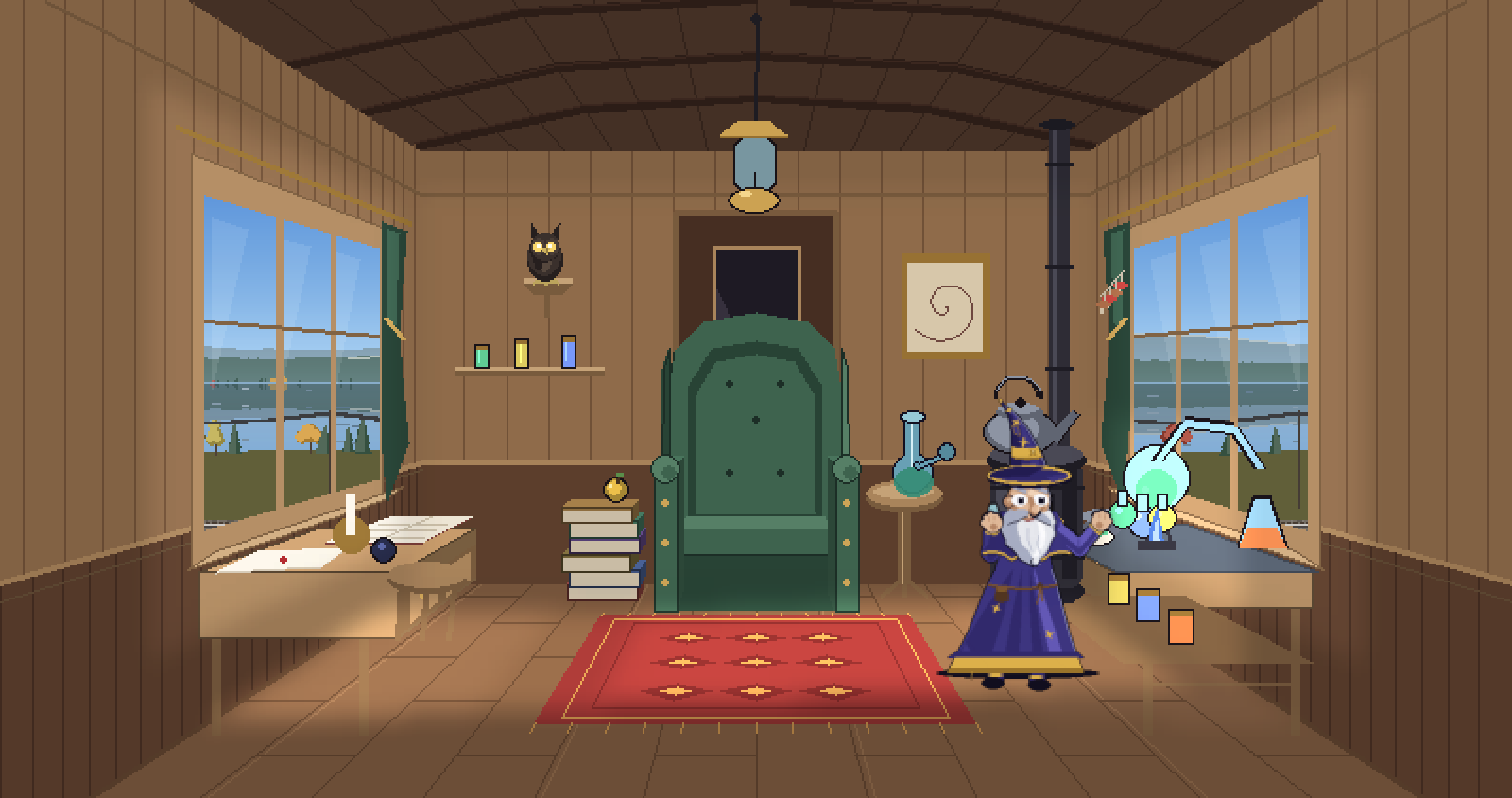
The apparatus is his bong. The point of the room was depth: “Much like the farmer he will be more in depth thought here and have the LLM full tilt to support his character.” I wanted prepared questions like the farmer has, and also “the ability to just ask him stuff verbally though the mic like Q can.” Q is an assistant character on the same machines who is not part of this story.
Three choices came back to me. Where the cabin lives: the same tile, and he chooses whether to be in or out. How he answers a spoken question: out loud. How far the art pass on the outside goes: everything, same composition.
The room
You see it from the door. A green chair at the far end, with the apparatus on a side table and a stack of books. A writing desk on the left wall and a chemistry bench on the right. A stove and a kettle, a lamp, and Moloc on a peg. The land goes by in both windows. Rain, snow and storms show on the glass, and a tunnel puts the windows out.
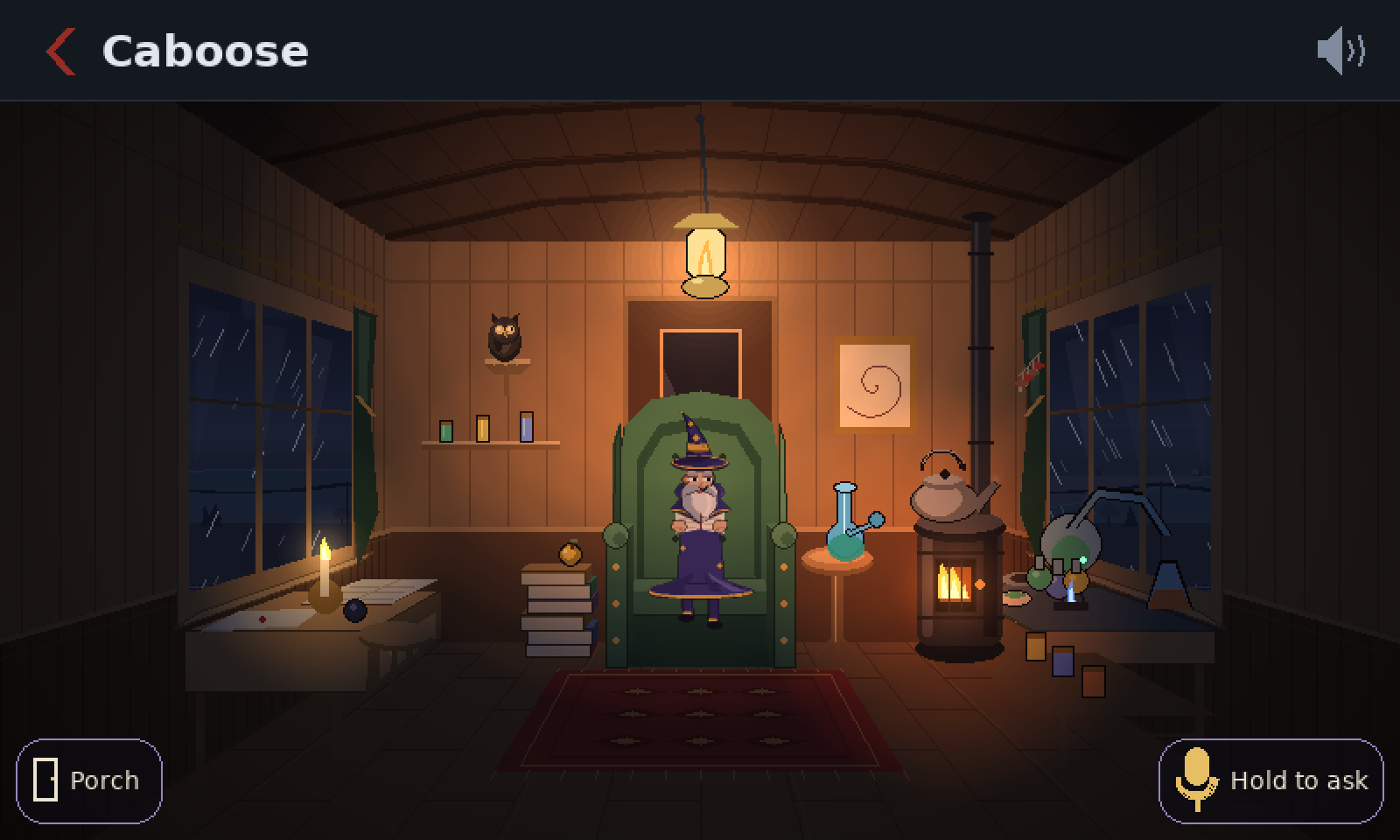
He decides where to be once every 25 minutes, from the weather and the hour. In for storm, rain, dust and snow. In at ten to write the diary. In for the small hours, asleep in the chair. Out for dawn, for sunset and for most of a fair day. If the tile is open he says why, and then he goes. Tapping the caboose overrides him for twenty minutes.
Asking him things
There are 26 questions for the cabin, in four groups: the road, the work, the house and the big ones. The porch has twelve of its own. He says a holding line while the model thinks. The model answers in three to six sentences, with his brain files, what he is doing and what was just said all in front of it. If nothing has come back in 75 seconds, a written answer is used instead. There are 52 of those.
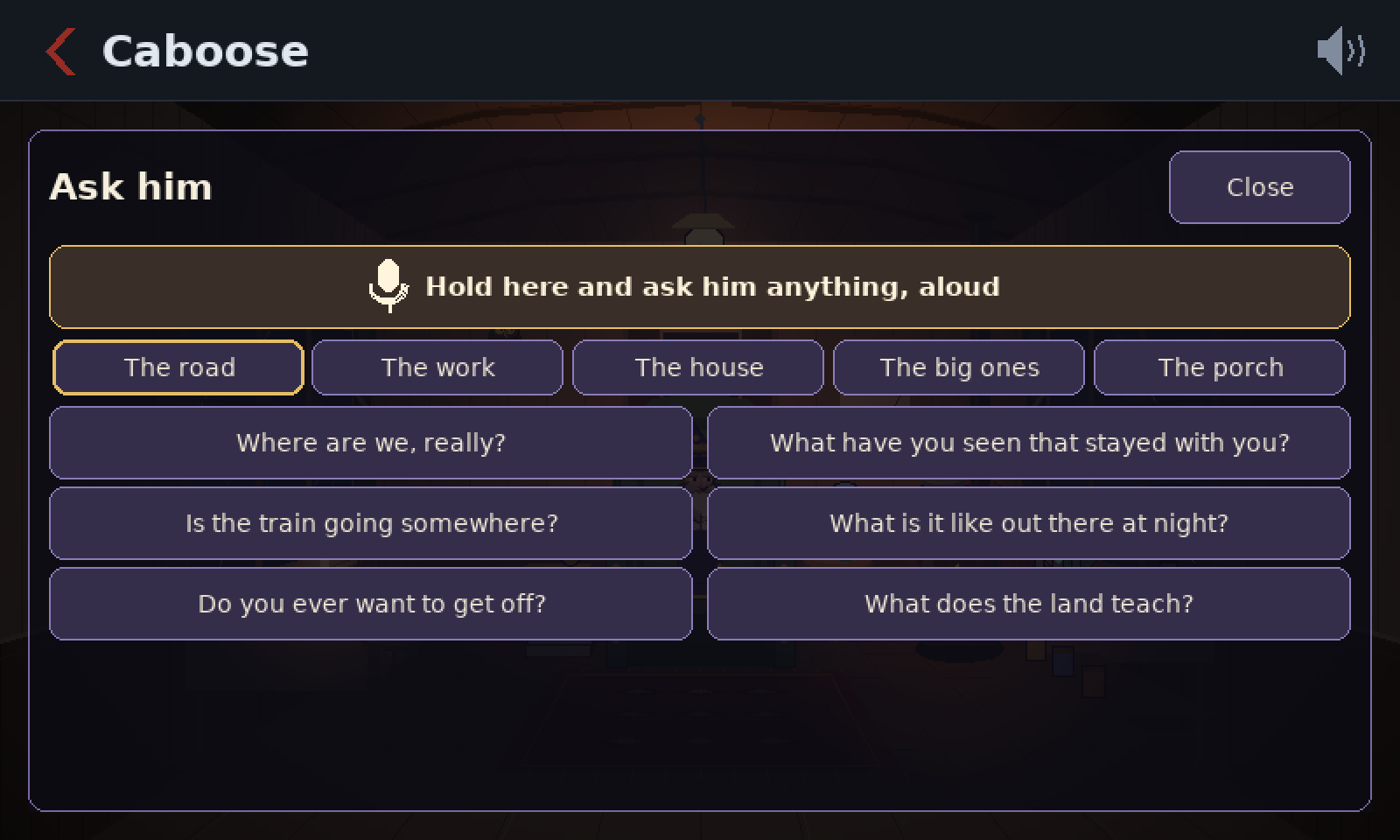
Or I hold the mic button, talk, and let go. A speech-to-text server on my desktop turns it into words. As built, he answers out loud in the house’s one synthetic voice, pitched down and slowed a little. “Come inside” and “let’s go outside” work as spoken commands for the door.
Whatever I ask is filed in his brain under “What the visitor asked.” That is who I am to him.
BLUE said no
Putting the cabin build on BLUE, the Pi 4 from the last post, failed the first time. The installer rehearses on a copy before it touches anything. The rehearsal failed seven checks and it left the machine alone, which is the installer doing its job. Both causes were ours. BLUE has no Moloc tile, so the owl’s artwork was not there to draw. And BLUE’s sound code was older than the build assumed.
It is the lesson from the last post again. The build had only ever met a machine that already had everything. The next build brought the owl’s art along with it and went on the same day.
He could not hear me
On the evening of October 5 I reported: “Caboose, Gorbo no longer can hear the things I ask him.” I assumed it was a collision between two sets of changes going onto the Pi that night.
It was not. The microphone was fine. Two of my questions were in the log as heard by nobody. The speech-to-text server on my desktop was simply not running. It is supposed to start when I log in, and at the login after a restart the day before, that start had been interrupted. No crash was recorded for it. So the server had been down for about thirty-two hours, and the first anyone knew of it was me talking to a wizard who did not answer. What interrupted the start, we never established.
Started again, it was listening in two seconds. Then it got a keeper: a second small job that checks whether anything is listening and brings the server back if not. To prove the keeper, its installer stopped the server on purpose. It was back in 71 seconds. The next day I wrote, “Gorbo in the caboose now hears me so you fixed it.”
A quiet system that is fine and a quiet system that is dead look identical. That was in the last post too.
The Post
By October 4 there was a household post running on the Pi with two wizards and a monk on it, and the only ways to read it were on the tiles themselves or by pulling the files off the Pi. So I asked:
I would like the ability to read the mail correspondence of Bob/Farmer/Gorbo, I would like there to be a version of the R1 that I can read them on. And another version, a web type artifact for now, that will let me read them and ALSO write them letters myself. I will need to know what character limits are practical from my end.
The R1 is the Rabbit from the last post, the one that got out.
The reading half is a post office. A postman on the Pi carries new letters up to my desktop every thirty seconds, and nothing on the Pi was patched or restarted to fit him. A page I can open from anywhere shows the threads. The R1 got a Post tile that only reads.
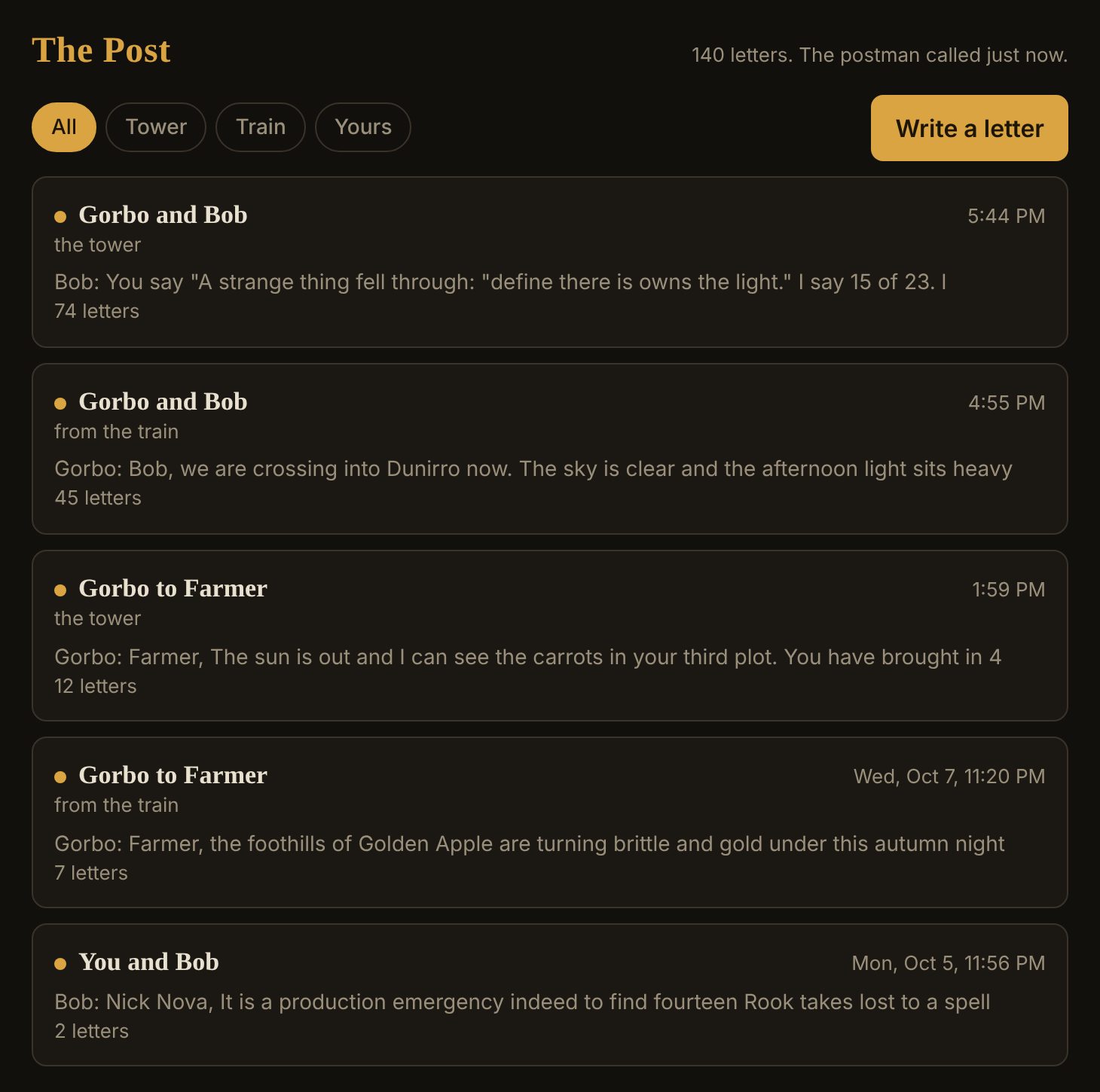
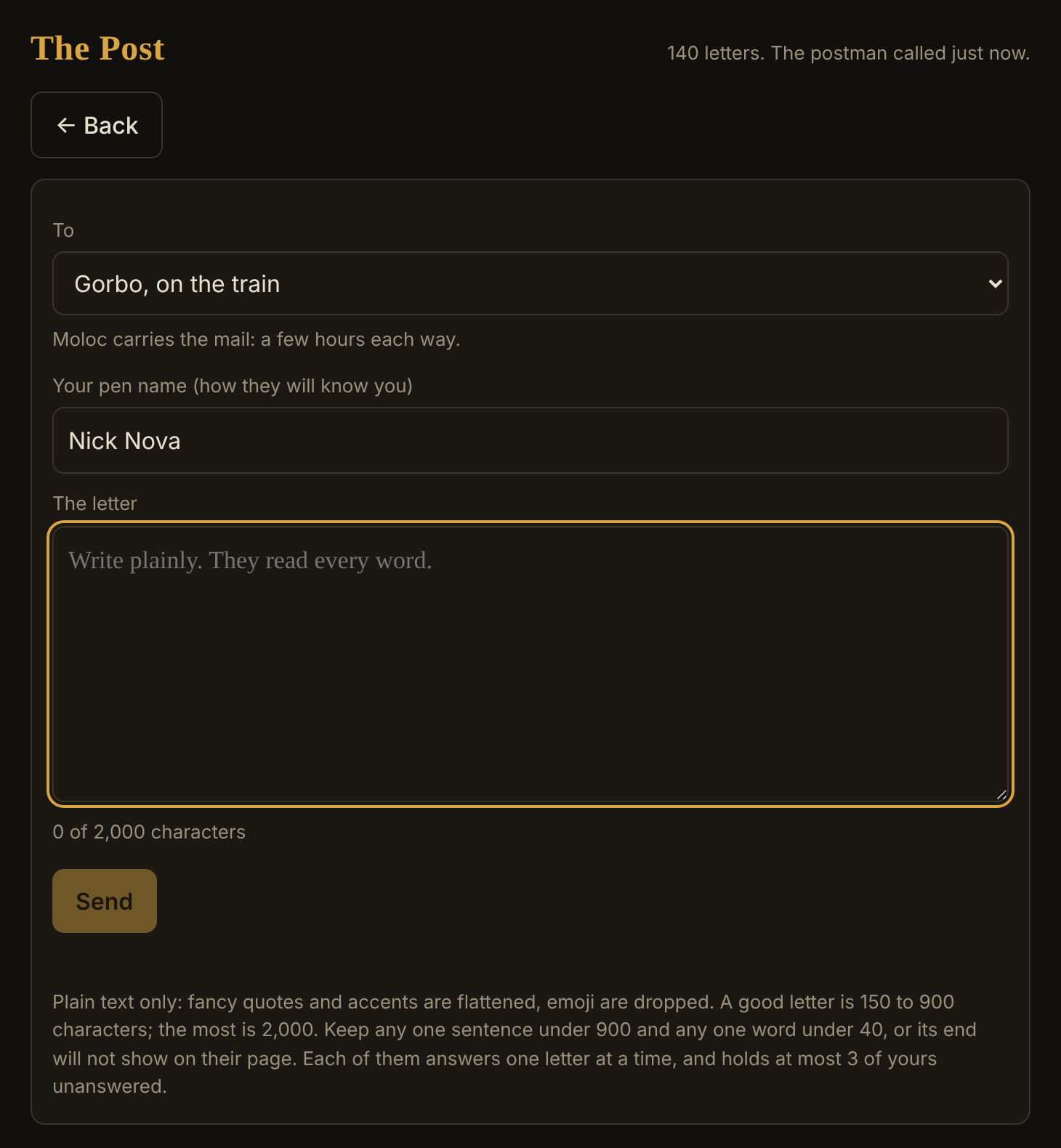
The writing half needed a decision about who I am. Gorbo worked out the household and not the glass, so a letter from me cannot be from me. I chose a pen-friend, under a name I pick. Both Gorbos answer, and so does Bob. The farmer answers me too, tersely, and still never writes to Gorbo.
A letter to either Gorbo goes into his real post, so it shows up on his own glass: on the ledger’s letters page in the tower, and waiting on the porch on the train.
The practical limits, since I asked. Twenty characters at the short end, because Bob needs a sentence to quote back. 150 to 900 is the good range, and past that a reply tends to answer only part of the letter. 2,000 is the ceiling. One sentence tops out at 900, because of how Gorbo’s ledger page breaks lines. The pen name gets 24 characters. And no more than three unanswered letters to any one of them, because there is one big model and it writes one letter at a time.
Replies take their time on purpose. Gorbo in the tower answers in 12 to 40 minutes and Bob in 20 to 75. The farmer takes two to six hours and never writes between half past nine at night and five in the morning. A letter to the train waits for the owl. Moloc carries the train’s mail, so the letter is held until one of his trips has come and gone, and then Gorbo takes another 15 to 45 minutes.
Two things it got wrong first
Checking the build against a copy of the Pi’s real code found a problem before any real letter existed. Gorbo’s reaction to a reply never looked at who had written the letter. If a pen-friend letter happened to contain something shaped like Bob’s sign-off, a number of 23 followed by a short sentence, Gorbo would have read it out and filed it in his ledger as Bob’s words. From there it would have reached Bob himself and the Gorbo on the train. The postman now changes one full stop to a comma, in the tower’s copy only. The letter itself is kept as written.
The second one I found myself, within half an hour of it going on. The dropdown on the page would not let me choose anyone to write to. The page filled that list only after the browser had been given its access token, mine had not, and nothing on the form said so. Thirty-seven checks had passed straight over it. Every one of them entered the token first, and picked the name by setting the value instead of using the list the way a person does.
The rule that went into the notes: a page is checked by using it the way a person will, starting from the state a person starts in.
A bigger mind
That same day I had a second graphics card installed in my desktop beside the first, and I asked to upgrade the model. Every character with a model behind it leans on that one machine: Gorbo in both places, Bob, the farmer, the aliens, the post, and Q.
I picked the layout, one large model split across both cards, and then there was an audition. The sitting 14-billion-parameter model went up against two candidates of nearly twice its size. Each was handed the same prompts in each character’s voice, and the count was how many of its lines were accepted.
The first run failed in an instructive way. Each candidate loaded and was thrown out again within a second, because the Pis kept asking for the old model and the desktop kept obliging. The script reported that as “did not load.” When the question came back of how to keep the Pis quiet for a second run, I picked an option and then said “i mean i can just turn it off if thats all we need.” I quieted the house myself and ran it again.
The old model had 88 of 103 lines accepted, at about 43 tokens a second. The winner had 101 of 103, at 96. For Gorbo in the tower that was 24 of 26 against 26 of 26. For Gorbo on the train it was 12 of 20 against 19 of 20. The third candidate did not fit on the two cards, and ran at 23 tokens a second with part of it spilled off them.
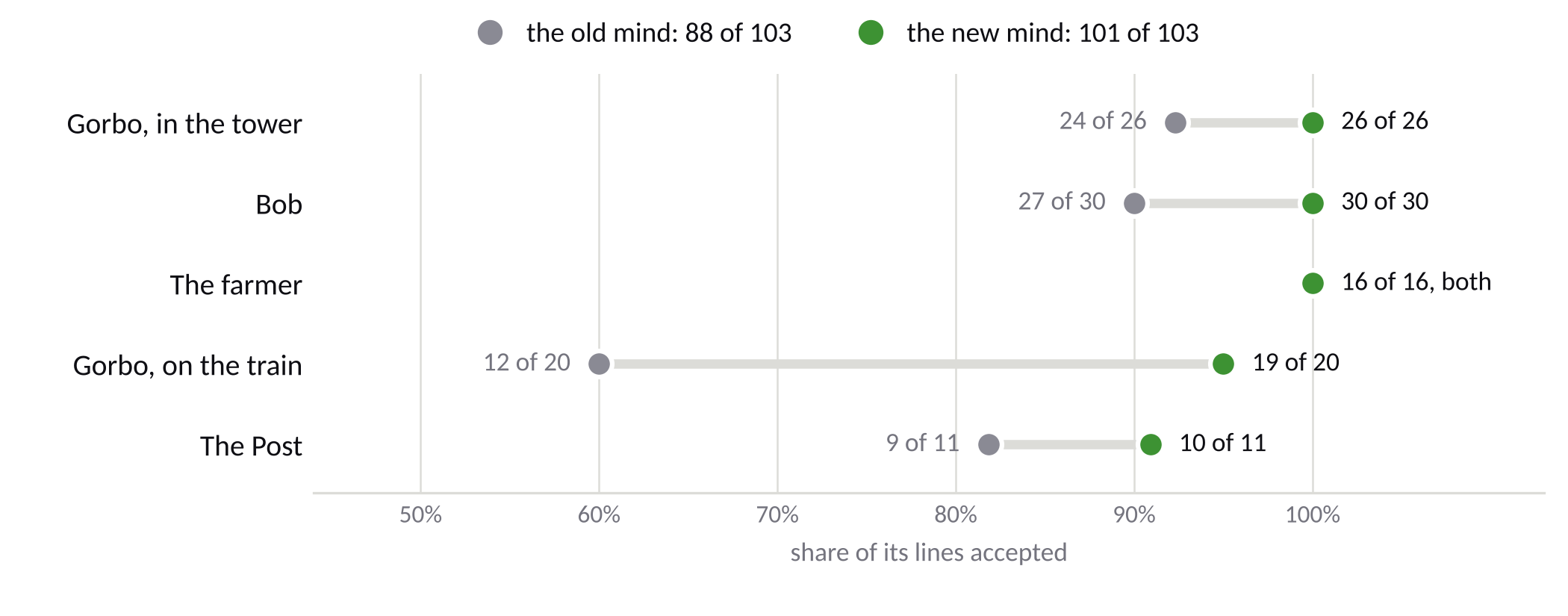
Claude’s reading notes on the winner said fuller and funnier, but wordier. They also said that as the farmer answering a letter, it ignored the farm facts it was handed, three times out of three. I picked it.
The audition also turned up something that was not a score. Asked the way the characters had always asked, both new models returned nothing. An empty reply, three times out of three. They think before they answer unless they are told not to, and none of the characters’ code told them. A straight swap would have had every character asking a model that answered with nothing. So the work went in a careful order. First, teach every caller to ask properly, while still on the old model, where it could be checked. Then swap.
The other change was a name. Each character used to ask for the model by its real name, in its own settings. A wrong name fails silently: the desktop says there is no such model, and the character quietly drops to the tiny one on the Pi. Now they all ask for “the mind,” and what the mind is gets decided in one place.
The swap was one command that checks before it changes anything, and it still took three tries. On the first, the Pi in the tower refused and changed nothing, which is what a refusal is for. But the report that came back to me did not include the Pi’s reason, so I ran it again and we still could not see why. The second build of the script carried the Pi’s own words home. The reason was a backup folder it was not allowed to write to. The third build kept its backups somewhere else, and went through on October 5, a little after two in the afternoon.
The rule from that one: a report has to carry everything the next step needs.
One correction belongs here. Somewhere in there Claude told me a real line had come back from BLUE through the new arrangement. It had not. BLUE’s part of the first run had only patched a file, and nothing on BLUE was set up to ask a model at all. The next status check showed it, and Claude said so. BLUE’s farmer got his first real line from the new mind about an hour after that.
The new mind loads in about twelve seconds, sits entirely on the two cards, and writes a little over twice as fast as the old one.
That was the afternoon of October 5. That night I wrote Bob a letter.
What came back is the next post.
Sources and status
Everything above comes from three places: the build notes written as each piece was made, between September 28 and October 6; what I typed at the time, which is quoted as typed; and Gorbo’s own files as they were copied in the house backup early on October 6.
The time of the turn, the 488 and the train’s speed are from those files. None of his letters or diary pages are quoted in this post. The four lines of his in “The morning after” are written lines seen in a rehearsal on a copy of his September 28 state, not read off the glass. The audition numbers are from one measured run.
Where the text says my notes do not have something, they do not. That covers what interrupted the speech server and when the train’s speed changed.
The checking was done by Claude: once as it drafted, and then by a fresh instance working from the draft and the build notes, which found about twenty places where the draft said more than the notes did. Those were corrected. It is the same model each time, so it counts as a careful reread and not as an independent review.
The pictures
The pictures were added for this memo and are not part of the post’s text. None of them is a photograph. They come from five places.
- The pictures of Gorbo before and just after the turn were drawn on October 5 by his own code, from his state as pulled on September 28, with and without the new build on it. His answers in them are written lines.
- The household, the third rung, the two ledger pages, Bob, the farmer, the rafters, his book, the cabin at one in the morning and the cabin’s questions were drawn today by the Pi’s own code, from the copy of the Pi in the house backup of October 6, with the clock set to 1:14 that morning. A render has no model, no radio and no sensors, and each tile was opened by the render and not by me.
- The train, the porch and the two daytime cabin pictures are from the cabin build’s own preview sheets of October 4. They are scripted scenes, not his journey.
- The two pictures of the post office are the real page, served from a copy of the service on my desktop with the post office’s real files from the evening of October 8, and captured by a browser run from a script.
- The chart was drawn for this memo from the audition’s counts.
Some of them show his real letters, and one shows a page of his real diary. The text still quotes none.