

Memorandum
Dead Air
A late-night radio station, a guest with a floor plan of the Moon, and a room full of tapes

Doctor Adrian Vale has spent seventeen years investigating whether the Moon is a municipal annex. He has brought a floor plan. He has forty-three returned letters addressed to Lunar Maintenance. He regards the fact that none was marked “department does not exist” as evidence.
Joe Malick has given him a microphone.
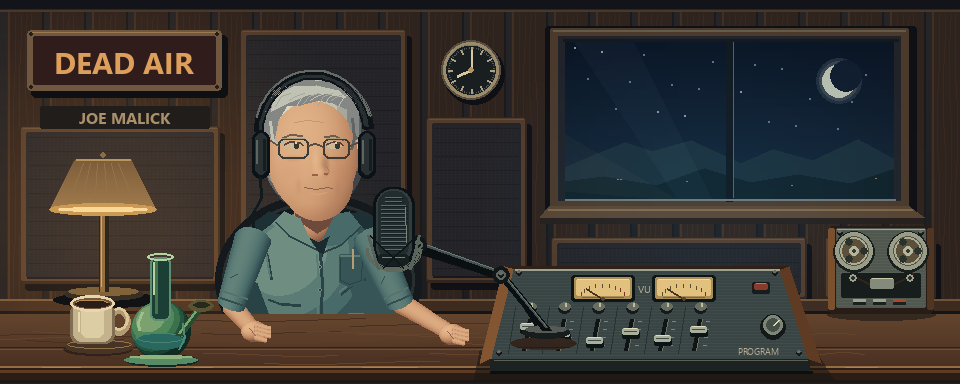
That is Dead Air. An overnight paranormal radio comedy with a warm host, guests who have brought entirely too much evidence, and callers who meant to clear something up and have made it worse. It lives on the Crackpot, the Raspberry Pi household from the Grub post, and now there is a Tape Room here on Strawberry Napalm where anyone can listen.
The public collection starts with the core nineteen programs and carries on through fifteen saved generated nights. Thirty-four complete broadcasts, about five hours. If you would rather hear what this is than read how it works, start there. Joe will explain the floor plan.
Same arrangement as the earlier memos: I say what I want, the assistants propose, I dispose. Claude built the station and its shows; Codex brought the finished tapes and the animated studio onto this site. The people on the radio are characters. Their extraordinary discoveries are fiction.
The man at the microphone
Joe opens the first program like this:
Good evening, wherever your night has taken you. I’m Joe Malick, and this is Dead Air. The road is quiet, the coffee is unreasonable, and our first guest has brought a floor plan of the Moon. If you’re driving, keep your eyes on the road. We will describe the floor plan.
I was a huge fan of Coast to Coast growing up as a mini lunatic. Dead Air is an unabashed homage, even if we take it in slightly weirder directions.
The form is familiar if you have ever left a radio on late enough for the ordinary world to stop calling. A long interview. Someone out on the road. A patient caller who has been holding. A commercial that sounds as though the station could not afford to turn it down.
Joe’s job is hospitality. His direction now is to be fascinated: ask what happened next, what the thing looked like, what arrived at the loading dock after midnight. Let a guest develop the whole explanation. He does not need to certify it. The first four shows have more of him testing the argument; the later writing leans further into giving these people room.
Nobody needs to announce the joke. An investigator can be entirely serious about a committee that took nineteen months to approve throwing away a miniature kettle. Once the kettle had been there long enough, it became an exhibit and could no longer be thrown away. Doctor Vale lost his dining room to that experiment.
The useful part is the kettle. Give an impossible institution a procedure, a broken appliance and somebody who has been waiting for an answer, and there is a whole evening in it.
The people who call
Vale is a courteous independent investigator of impossible civic infrastructure. He brings diagrams. Vera Hollis brings procedures and admits when a result is inconvenient. These are different kinds of trouble.
Dennis drives nights out of Omaha and has actually visited some of the places under discussion. Mara works the night shift and owns a microwave that allegedly receives tomorrow’s weather. Len works dispatch and knows there are departments operating between Thursdays. He would like the paperwork to be clearer.
Then the household starts calling. Gorbo is still a wizard. Bob is still a monk with a question about the premise. Farmer has a dog, Tater, and objects to being made an expert on things he has not agreed to be an expert on. Ticker can find a market in nearly anything. These are written radio appearances by those characters; the show is not reading their private letters onto the air.
The third set of shows added Delphine Rook, written by Wit, counsel for the unexplained. Sole practitioner at Rook and Associates. She will not say how many associates there are. Her office is a self-storage unit and her files are in a chest freezer, for chain of custody.
Her first question to Joe is:
Thank you, Mister Malick. Before we begin, can we stipulate that it is night?
Joe is happy to stipulate.
Rook represents phenomena. Vale wants to establish what a thing is; she wants to know what it is owed. The Wow Signal would like its call returned. Seven has never been paid. By the end of her five-show cycle, the station itself has become involved in the paperwork.
Her delivery stays perfectly level. She bills in six-minute increments. Another one has begun.
Nineteen programs to begin with
The core is three sets, in their original order.
The first four. The lunar annex, a rest stop that moves overnight, the Moon Matrix and a broken remote, and tomorrow’s weather arriving ahead of schedule. They establish Joe, Vale, Vera and the callers.
The next ten. Roswell acquires a motel guest. Majestic Twelve has open mic night. Denver’s baggage claim returns a life its passenger did not live. Houdini is still on hold. The Philadelphia Experiment has misplaced the sea. Bob and the rest of the household keep coming back.
Three of those ten are adaptations of SCP Wiki material, including a guest who is very difficult to remember. Their source authors and licenses travel with the programs. Open Sources & credits in the Tape Room to read them.
The last five. Rook’s cases. Her version of the unexplained has clients, standing and outstanding invoices. By then there is enough shared history for a caller’s practical objection to become somebody else’s evidence.
Some programs begin with real historical events or published conspiracy lore. The episode notes distinguish that starting point from the invented interview, guests and caller reports. The stories do not turn those claims into established facts. The automatic writer makes original fiction and does not retrieve live news.
A person can listen in order and pick up the callbacks, or pull one tape and be met by Joe at the door. The first episode is The Moon Is a Municipal Annex. A little later, The Guest Nobody Booked is a good example of how an impossible premise can turn into a small courtesy.
How the station makes another night
The station in the house can ask for a new program while the existing recordings play. It gives the local writing model a cast, their habits, a concrete subject and a few recent caller reports. A basement where unspent minutes are stored in jars, for example. Or an inland lighthouse receiving complaints from ships that cannot reach it.
The subjects rotate through a written list. The model develops the interview around them. Its continuity is a supplied selection of recent material, so familiar characters and callbacks are possible without pretending the station remembers everything it has ever said.
What comes back is a script with a speaker assigned to each turn. Opening, interview, callers, station break, closing. Joe opens and closes. There have to be enough voices for a conversation, and the announcer gets the commercials. New ordinary programs aim for roughly fifteen minutes; the shorter early recordings keep their original dialogue.
Then the script has to become sound. Each turn goes to the house’s speech setup under that character’s voice profile. Joe gets his low overnight voice; the guests and callers keep theirs. Bob and Farmer use their approved character performances. The announcer approaches a fictional product with more confidence than its warranty deserves. These are synthetic performances, not recordings or cloned voices of real radio hosts.
The audio is checked, with retries when a take fails. A program joins the playable station only when every spoken turn has a recording. The small Pi does the station work; the computer supplies the writing and voice services. Already recorded programs can play without asking either model to do anything.
One consequence of that all-or-nothing admission rule was unpleasant. A script could be written successfully and then disappear because a voice line failed. The writer had done its work. We had thrown the words away at the microphone.
The station now saves the writer’s returned words before parsing them, the normalized script before recording it, and each successful voice take as it goes. Failed and rejected drafts remain drafts. They do not get passed off as complete broadcasts, and saving them does not make a failed recording pass. It means the words survive to be worked on.
The fifteen generated shows in the public room are finished recordings that were already saved. They are what the station actually made from its prompts, including its recurring interests in municipal storage, premature library returns and the administrative problems of inland lighthouses.
The window
Joe has headphones, coffee, a mixing desk, a reel-to-reel and a view of the mountains at night. His mouth moves when he speaks. The needles move and the reels turn while the tape runs.
Occasionally something goes past the window.
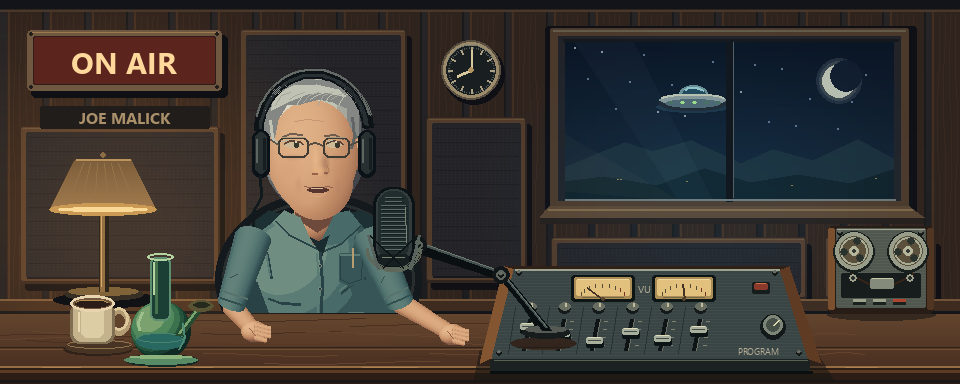
There are three kinds of incident: a hovering saucer, a fast burning flyby, and a cow being taken up in a green beam. Most of the time there is just a window. Joe has an interview to conduct.
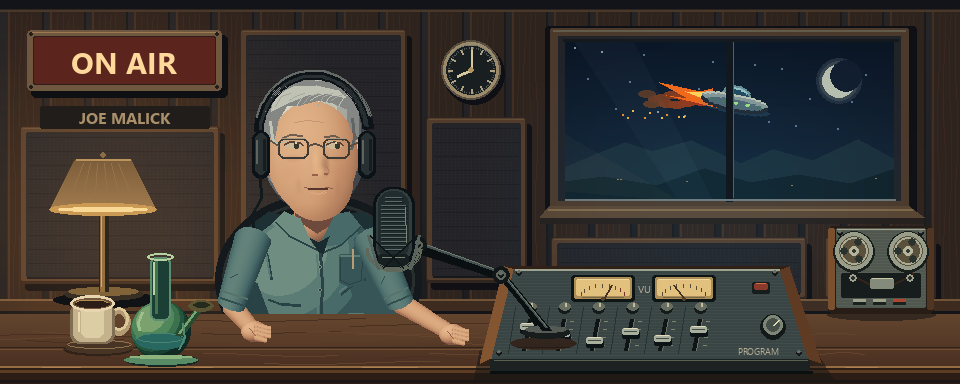
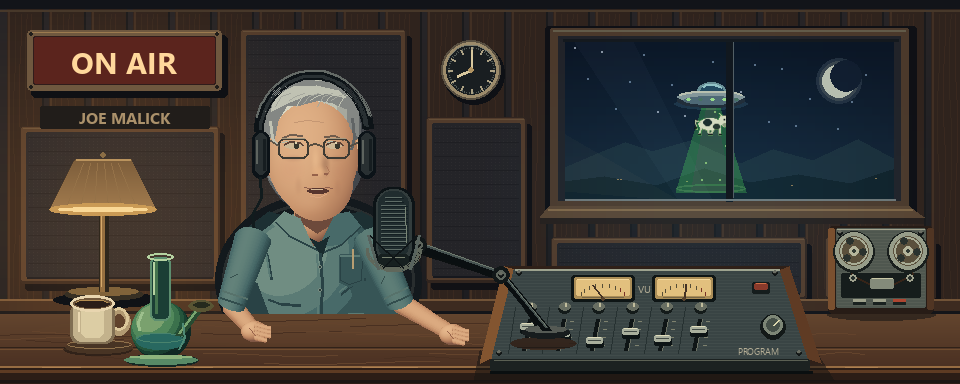
For the website, the drawings were rendered into small sheets of animation frames. The browser plays those locally and uses the recording’s timing to know when Joe is talking. The view is an animated illustration of the studio, not a camera feed from the house. What happens outside is timed scenery; a cow does not rewrite the interview.
The animation pauses with playback and rests when the tab is hidden. There is also a switch to turn it off while the audio carries on. A reduced-motion preference starts it off. The original house app has a Big Rip button; the public room has the listening controls and the window incidents.
A room full of finished tapes
The house has a working station. The public website has its finished recordings. The distinction was part of the request from the start: “nothing they do interacts with our actual generator.”
So the public player asks this website for an MP3. It has no route to the writer, the speech services or the station’s controls. Listening does not commission a show, consume a voice job, change the Pi’s place in a program or add to the household’s broadcast history. A thousand people can pull the same tape and Joe in the house will never hear about it.
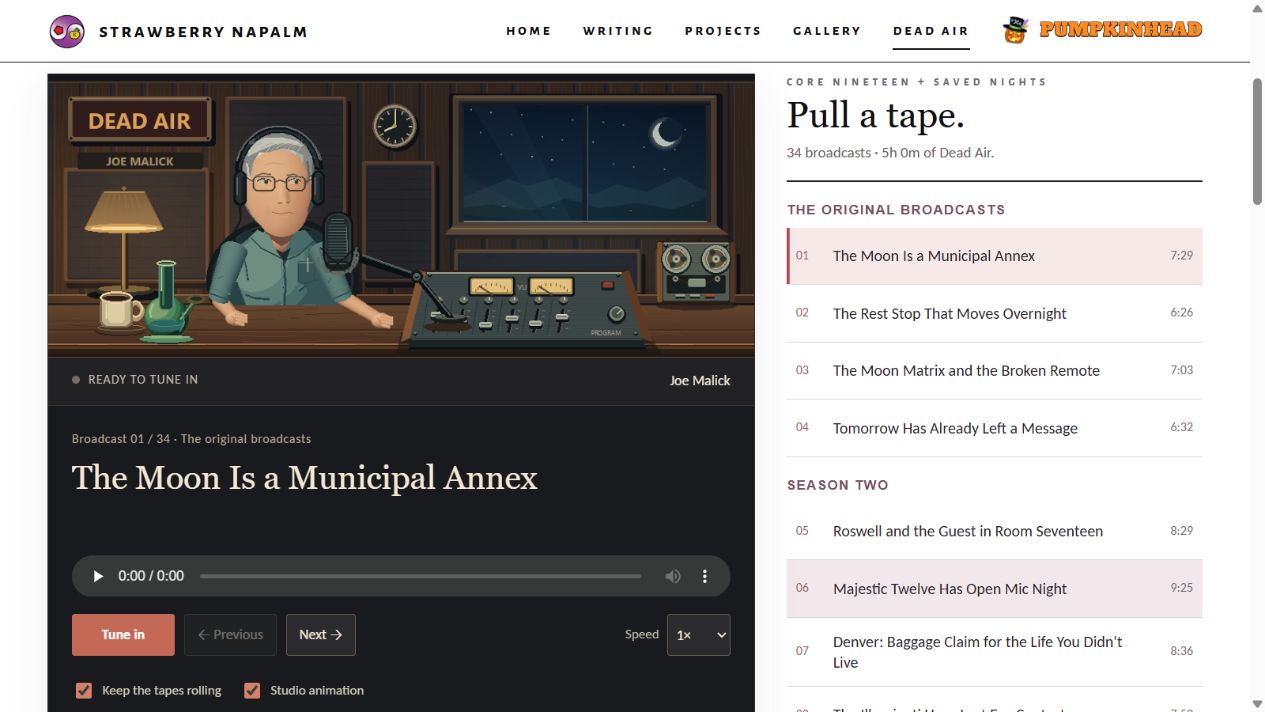
Press Tune in once and the next broadcast starts when the current one ends. Keep the tapes rolling repeats the collection after the last recording. The saved nights follow the core nineteen, oldest first. They are a published selection of the archive, not an automatic feed of whatever the generator does next.
Every tape has its transcript. Open it and click a line to seek to that part of the recording. There are downloads of the MP3, the readable transcript and the episode script, plus a playlist for a player of your own. Sources and adaptation credits stay attached to the episode they belong to.
The computer in the house can be off. The Pi can be doing something else. These tapes have already been made.
Pull the first one. Doctor Vale has been waiting to show you the receiving entrance.
Sources and status
This memo describes the station and the public collection as of October 16, 2026, Eastern time. The station account comes from its source, program guides, recording and archive notes, and the installed draft-preservation release. It is not a fresh claim that every house service was exercised for this post.
The quoted Joe opening is from the first program’s transcript. Rook’s greeting is from her first appearance. The core scripts, generated scripts, full dialogue and individual sources are available with their recordings in the Tape Room. The three SCP adaptations retain their individual attribution and CC BY-SA 3.0 terms there.
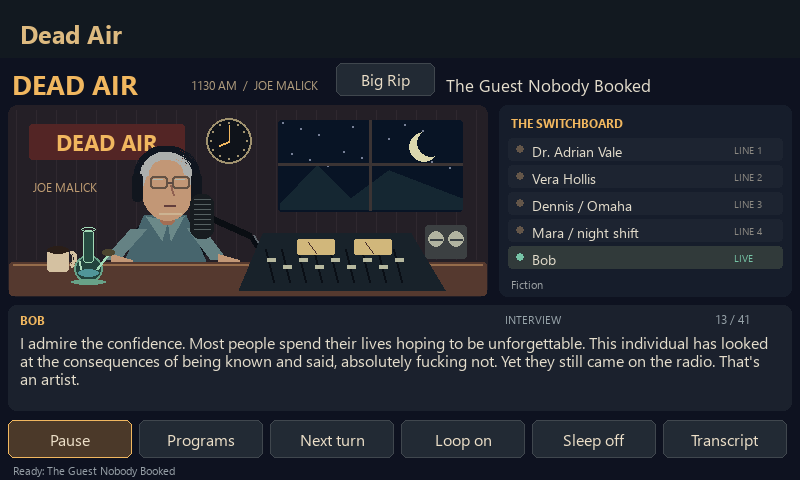
The adapted dialogue in the picture of Bob belongs to The Guest Nobody Booked, based on SCP-055 by qntm and CptBellman and We Need To Talk About Fifty-Five by qntm. Its new radio dialogue and story are released under CC BY-SA 3.0. It is not an official SCP Wiki production.
The public release was checked for playback, seeking, the change from core nineteen to saved broadcast twenty, and the repeat from the last tape to the first. It does not offer a live writing control or automatically publish future recordings.
The pictures
The first picture is the public player’s existing studio poster, rendered from the approved native artwork. The old studio with Bob is an existing staged preview from the earlier build. The three window incidents were rendered for this memo from the current approved drawing modules, with chosen animation times and no station, model, voice service or private saved state loaded. They illustrate the events; they do not document a particular broadcast encountering them. The last picture is a browser capture of the public Tape Room.
The paper, letterhead, coloured section marks, paint drops, captions and picture viewer are the same ones used by the Grub and Gorbo memos.